Get Visual is the grateful recipient of a grant from The Christos N. Apostle Charitable Trust
Showing posts with label african-americans. Show all posts

Tuesday, April 5, 2022

Not to be missed

Penny Dreadful by Nina Chanel Abney is among works by 59 artists at The School
Longtime Times Union art critic (and fellow fine art photographer) William Jaeger has written a powerful review of the exhibition This Tender, Fragile Thing at The School in Kinderhook.

I won't have time myself to review the show, which will end on April 30, but I wanted to pass along Bill's endorsement before its too late.

The show is a re-examination of a prior exhibition mounted by The School in 2005 that highlighted Black Power-related materials from the gallery's collection, and features the work of 59 significant artists, including photographs by prominent journalists. The School is a vast, pristine space, and admission is free - but it is only open one day a week, Saturday, from 11 to 6, so plan accordingly.

Sunday, March 13, 2022

Robert Blackburn & Modern American Printmaking at The Hyde Collection

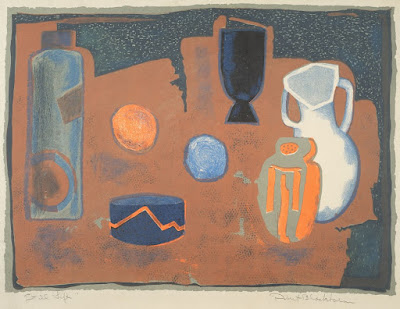
Still Life (aka White Jug), c.1950, color lithograph
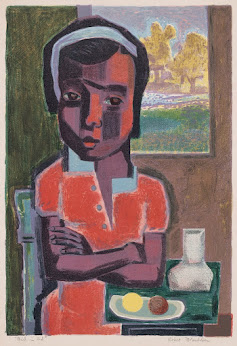
all works by Robert Blackburn
The name Bob Blackburn is unlikely to ring a lot of bells with the average art viewer - but a show currently on view at The Hyde Collection in Glens Falls through April 24, could change that.

Girl in Red, 1950, color lithograph
Organized by the Smithsonian Institution Traveling Exhibition Service, and ably curated by Deborah Cullen, Robert Blackburn & Modern American Printmaking, is a show with a story that blends 20th-century American art history with African American history (in other words, highly relevant), while revealing a tremendous talent that was largely overlooked - but not necessarily due to the artist's skin color.

Because Blackburn dedicated himself largely to producing lithographs, etchings, silkscreens, and woodcuts for other artists, his devotion to his own career as an image maker took a back seat. He describes this choice himself in a quote on the gallery wall (one among many that perfectly accompany the works of art in the exhibition), saying "I was torn between building something which I thought had value and doing my own work."

In fact, he succeeded at both, by establishing printmaking workshops that forever changed the way postwar artists used those media, thereby significantly affecting the trajectory of contemporary art, and producing numerous powerful original works in the same media on his own time. Many viewers will be thrilled to see prints here by artists such as Robert Rauschenberg, Charles White, and Grace Hartigan - and those are great! - but I'll focus my comments on Blackburn's work, which makes up about half the show.

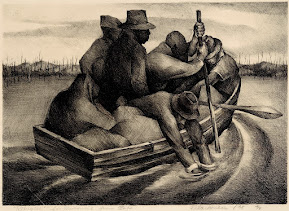
Refugees (aka People in a Boat), 1938, lithograph
It's immediately clear upon entering the gallery that Blackburn had tremendous ability as an artist. The first image, a lithograph he executed at the age of 17 in 1938, shows an already accomplished skill level, and a mature vision in step with the times. Entitled Refugees, the piece shows the influence of prominent socially conscious work of the period, such as that by Diego Rivera or Rockwell Kent, but stands on its own as a Depression-era cry of concern.

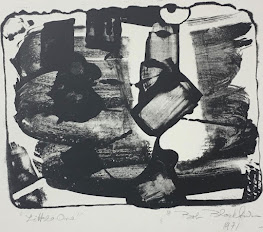
Little One, 1960s-1971, lithograph
Later works move on from figuration into abstraction. Blackburn pointed out his thinking on this process saying, "illustration was one thing and creating vital space is another." Indeed, "vital space" is what he delivers in print after print, whether injecting that into the work of others through collaboration, or in his own masterful pieces.

I had so many favorites around the two large galleries devoted to this collection that I hardly know where to begin. But I will say this: the medium was only a starting point. Blackburn mastered many, and he innovated in them all. So there are prints in almost every technique (including cutting-edge forms) that fulfill Blackburn's creative promise while amply demonstrating his technical contributions.

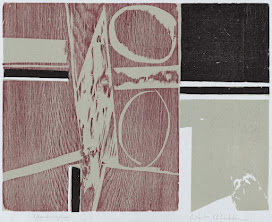
Woodscape, 1984, color woodcut
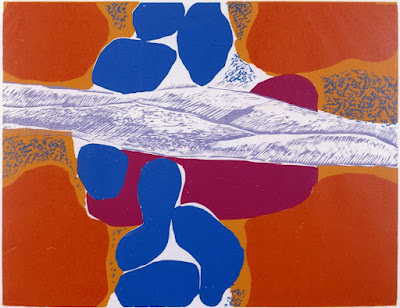
Among the characteristics that pervade the work, and which help it hold together as a singular body, are Blackburn's brilliant color sense, his compositional daring, and a playfulness that I honestly envy, all of which he maintained over more than 60 years, before illness slowed him down. Undoubtedly, the man worked day and night, and the artists he collaborated with provide quotes in praise of his constant willingness and easygoing personality - it seems they all loved being around the positive energy of Bob Blackburn.

It also seems Blackburn had no quarrel with his relative lack of recognition or fame, further underscoring the sweetness I feel when viewing his personal output. But make no mistake - that work is serious, and important. For each of the pieces I've selected to reproduce here, there are ten more in this wonderful exhibition that are just as good. Try not to miss it.

Blue Things, c. 1963–1970, color woodcut 


Thursday, May 28, 2020

In Memoriam: Duane Ivan Todman

A recent unfinished self-portrait by Duane Todman
It is with great sadness that I recount the death of Duane Ivan Todman, a 27-year-old multi-talented artist who was shot by an unknown assailant in Schenectady last Saturday.

Duane and I became acquainted two or three years ago when we met during a reception at Albany Center Gallery. He struck me immediately as an unusually serious person who was deeply thoughtful and very dedicated to his artistic pursuits. He showed an interest in having input from me, and we proceeded to talk from time to time about his pursuit of a career as a neo-Renaissance painter.

One of those talks took place in his studio at The Barn in Albany, where Duane also lived. Having lived in my own studio for many years when I was younger, this was a very comfortable experience, leavened with philosophical discussion and casual critique of his current work, which included portraits, still lifes, and figures.

Duane made great progress in his technique during the few years I knew him, and regularly told me he was seeking the right studio school in which to hone his skill. Apparently, he was about to realize that next step in his dream, as an obituary in today's Times Union reports that Duane had won a scholarship to the Academy of Realist Art Boston, and was set to go there next year.

Duane also was reported to have been working on a book, a screenplay, and musical recordings.

In our last email communications, which took place in March, Duane mentioned the book project and asked me if I'd be willing to read a first draft, to which I enthusiastically agreed; however, he hadn't yet followed up on that, so I never learned what the book was about.

At that time, he also sent me images of two paintings, one finished and one in progress, which I include with this post. As you can see, they are both excellent. Based on the strength of these paintings, I initiated an attempt to connect Duane with a New York City-area dealer of African American painters, but that had not yet borne fruit - perhaps stalled by the intensity of the pandemic in that area.

Now, with one brutal and senseless act, all that promise is gone, and we are left to grapple with the loss of this fine young man. One can only hope that Duane's killer is brought swiftly to justice, and that his family can temper their grief. May he forever rest in peace.

A recent figurative painting by Duane Todman

Saturday, June 30, 2018

Upon the Ground, Below the Water at Albany International Airport Gallery


It can be easy to forget that the Albany InternationalAirport Gallery is one of the premier contemporary art venues of the Capital Region, right up there with Skidmore College's Tang Teaching Museum and UAlbany's University Art Gallery. Even more impressive is the fact that the Airport Gallery claims this high ground under a mandate of showing only regional artists.

But, for those of us already in the know about the Airport Gallery, and aware of the strength of our local artists, it comes as no surprise that Upon the Ground, Below the Water, the current show there through Sept. 3, is quite a knockout. Featuring six artists in a broad range of media, the show's theme is, in effect, our landscape - but it approaches the subject indirectly, in part due to a leaning in the direction of watery subjects (liquid or frozen), and in part due to metaphorical elements among these artists.

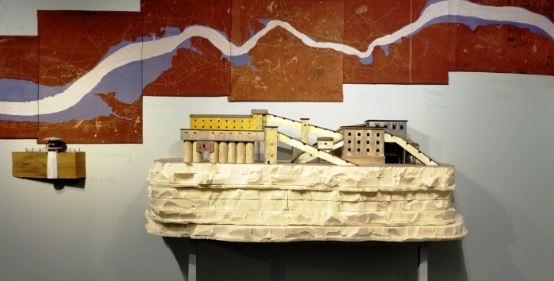
Kingsley Parker's 2018 mixed-media piece The Quarry
is paired with his 2014 wall-mounted UpRiver
The result is an immersive experience well worth a special trip to the airport (that is, if you're not already taking a special trip from the airport, in which case you'd be advised to budget an extra half-hour or so to peruse the show before going through security). As ever, the casual visitor gets a free half-hour in short-term parking, and you can get your parking ticket stamped at the Arts & Culture Program office or at the first-floor Departure shop for additional free time.

So, there's no excuse not to give yourself the pleasure of viewing Kingsley Parker's sprawling mixed-media wall piece UpRiver, or Richard Barlow's grid of 100 meticulous ink renderings of peeling paint transformed into new islands, or Daesha Devรณn Harris's masterfully evocative photo-collages under poetry-etched glass. And that's just a sample of the outstanding work in the show by these three participants (each offers other significant work as well).

Parker was the big revelation for me here. With his charming fixation on fishing vessels and inventive application of materials as modest as a #2 pencil and as labor-intensive as embroidery, he addresses environmental, economic, and graphic challenges in one fell swoop. It's a tour de force of art's profound ability to entertain, educate, and engage.

Terminus 2016 PLA print by Matt Frieburghaus
Among the other surprises in this collection (and there were several, all of them pleasant) were Matt Frieburghaus's many iterations of pure-white, 3-D printed icescapes, inspired by a residency in the far north. Made of PLA (polylactic acid), they feel both mundane and pristine; they are also elegantly complex in their geometry. It's the first time I've seen 3-D prints that really impressed me as works of art.

Also impressive are Tanya Marcuse's highly detailed color photographs of densely furnished plots of ground, which look natural (i.e. from life) but are actually carefully constructed of natural materials in situ, resulting in tapestry-like tableaux of the place at your feet. These beautiful images have a subtly morbid undercurrent of elegant rot - something like life itself.

Equally inspired by the small details at our feet, Claire Sherwood presents a series of pastel-colored rock-like forms modeled after stones large and small - those found in her backyard as well as in the pockets of her young children. Sherwood's technique seems to be a thing in itself - incorporating steel, plaster, paper pulp, acrylic paint, and encaustic, but the sculptures end up feeling fluffy rather than weighty.

In addition to his small drawings, Barlow contributes a very large, three-sided wall piece depicting ice floes, in the same chalk-on-blackboard-paint technique that he used for a drawing in last year's Mohawk-Hudson Regional at the Albany Institute of History & Art and, more recently, for two drawings in the MHR Invitational at Albany Center Gallery. Harris, along with her collage series of beautiful African-Americans from the past, contributes a newer group of photographs and a video that interpret a metaphorical river passage.

Fresh Disruption 2018 mixed media by Claire Sherwood


One more thing: Speaking of Albany Center Gallery, another outstanding collection of regional artists is featured in the current show there. Entitled Wonderland, it is very different from the Airport show - brightly colorful, mostly abstract - but equally eloquent in stating just how strong and deep the local lineup of creators is. It runs through July 13.

Saturday, April 29, 2017

The Cosmic Perspective

Neil deGrasse Tyson and Karen Ciancetta share a photo-op
Do you think a two-hour lecture on physics would be a dreary exercise in relativity (as in how a short time can stretch to infinity)? If so, then you have never seen Neil deGrasse Tyson in action.

A full house at Proctors sat enthralled on Monday night as two hours flew by at warp speed, with TV's Cosmos star Tyson guiding us on a rollicking trip through centuries of scientific, cultural, and social ideas, illustrated with slides that communicated clearly and entertained fully.

Though he claims to prefer time in the lab, Tyson is a natural and enthusiastic showman who knows how to work a big crowd as if they were guests in his living room. Rarely have I experienced such a sense of intimacy among so many people. This is the Tyson charm - he may be a genius astrophysicist who regularly schmoozes with presidents and billionaires, but somehow from the stage he makes you feel like he's also happy to hang out with simple ol' limited you.

Meanwhile, he's teaching you lessons that could be some of the most important ones you will ever learn.

The theme of The Cosmic Perspective is to share with the general public the extra-proportional mindset that astrophysicists live with every day - as they are accustomed to seeing everything from a big-picture point of view: from biology and space travel to arithmetic, economics and war.

Tyson presents each topic in a humorous, yet well documented style, referring to his PowerPoint slides as needed, but riffing like the best professor you ever had crossed with a seasoned stand-up comic. Along the way, you are asked to question whether space exploration is a good investment (clearly, he thinks so), how the periodic table can be read as a history of different nations' passion for science, and why Americans tend to be so afraid of math that our elevators never display negative numbers for the floors below ground level.

Along the way, you may learn something about evolution (for example, we humans are more closely related to mushrooms than mushrooms are to green plants) about astronomy (the tiniest slice of a clear picture of the universe from Hubble will include countless billions of entire distant  galaxies) or about chemistry (the "noble" elements are called that because they don't bond - i.e. associate - with other elements).

And, ultimately, you will see both how utterly inconsequential our own actions are and how easy it can be to feel empowered to try to have a positive impact on our little world.

Tyson, like all scientists, owes a debt to those who came before him, and he honored many of those lights during his talk - but none so much as his direct predecessor, Carl Sagan, who he quoted at length in his conclusion, citing Sagan's elegiac book Pale Blue Dot, which really puts things on Earth into proper perspective. The book was inspired by a picture taken in 1990 by the Voyager spacecraft as it passed beyond Saturn. Tyson shared a reprise photograph of Earth, taken in 2013 by Cassini - which, in timely fashion, has begun sending back new close-up pictures of Saturn and its rings just this week, on its way toward total immolation in that planet's atmosphere.

The evening ended with a lively Q&A, leading Tyson to offer advice to one questioner (and the rest of us) on how to "talk to idiots": He advised empathy, patience, and the willingness to offer information. Tyson also emphasized the value of supporting STEM education as our path to a future as a world-leading nation - a status that he amply and viscerally demonstrated the US is rapidly losing. He also pointed out that our educational system must find ways to stimulate students' imaginations, rather than teaching them how to pass tests.

My one criticism of these conclusions is that, to stimulate the imagination, STEM must become STEAM - that's for Science, Technology, Engineering, Arts, and Math. I wish Tyson had publicly acknowledged the importance of the arts in developing good, young minds into critically thinking adults.

Finally, as you can see above, some people with special tickets, including my wife, Karen, were able to meet their idol backstage. While waiting, I had the good fortune of running into my friend Steve Tyson, a painter and professor of art at Schenectady County Community College. He would also be going backstage - to visit with his kid brother, the scientist. I like to think Steve might have taken the opportunity then to say a little something to Neil about the importance of that A in steam.

Cassini took this picture from behind Saturn, showing the "pale blue dot" of Earth 


Sunday, April 3, 2016

Alma Thomas at Tang Teaching Museum

Installation view of Alma Thomas at the Tang Teaching Museum.
Photo by Arthur Evans
I wonder what Alma Thomas's public school art students thought when, in 1972, their teacher - retired and elderly - became the first African-American woman to have a solo exhibition at The Whitney Museum of American Art in New York City.

The idea of an artist being that important and, yet, having had to teach school all her life is far from unique, but this extreme case is certainly food for thought. Skidmore College's Tang Teaching Museum in Saratoga Springs has, in a sense, rescued this delightful painter from obscurity a second time with a sharp, spacious presentation of about two decades' worth of her work (on view through June 5) in a show simply titled Alma Thomas.

Alma Thomas - Iris, Tulips, Jonquils, and Crocuses
acrylic on canvas 1969
The exhibition is certainly a revelation for me - I was only a schoolkid myself when her big show happened at the Whitney and, though I am a fan of the Washington Color School that Thomas was associated with (including such notables as Kenneth Noland, Morris Louis, Gene Davis, and Sam Gilliam) I had never heard of her. Featuring a few choice examples of full-on abstract expressionism at the start (and they are very beautiful), the show quickly moves from Thomas's earlier efforts to the late phase, when her talent found its full strength in a signature style of patchy vertical or horizontal stripes.

Along the way, she tried social commentary blended with abstraction, but made a decision that perfectly sums up the nature of this exhibition, described here in a quote:
Through color, I have sought to concentrate on beauty and happiness, rather than on man's inhumanity to man.


Alma Thomas - Apollo 12 "Splash Down"
acrylic and graphite on canvas 1970
No wonder she faded into obscurity! For what seems like half a century, the art world writ large has grimaced at the idea that a serious painter would give any thought at all to either beauty or happiness. But maybe the tables are turning at last. If so, and if this show is some evidence of a shift in that attitude, then I am relieved and grateful.

Like many abstract artists, Thomas was not avoiding subject matter per se - in fact, she still used representation in some of her work, as in her "Space" series celebrating the Apollo missions - rather, she was transforming her direct experiences into their essences via color and brushwork.

Alma Thomas - Cherry Blossom Symphony
acrylic on canvas 1973
This was most true in certain paintings about flowers or flowering trees. A later section of the show features two such paintings, each about 4½ feet by 6 feet, that shimmer with the vibrant sensation of taking a tree-ful of blossoms square in the face (as in the painting shown at left). Another, slightly earlier piece celebrates four distinct types of garden flower, not by representing their forms, but by dissecting their colors and organizing them into marching ranks (example near top of post at left).

At first, these dabbed stripe paintings were fairly flat but, as time went on, Thomas mastered a layering technique that led to far greater depth and complexity, even as her palette narrowed. By the end, she was making monochrome images, often with a great deal of white, frequently mosaic-like rather than structured into rows, and the freedom did her good.

Alma Thomas - Deep Red Roses Chant
acrylic on canvas 1972
While the show is sparse, there is a denser section that groups 25 smaller works on paper into a lovely constellation of framed pieces hung above two glass-topped cases holding a group of matted or unmatted sketches. These are all on loan from the collection of The Columbia Museum in Columbia, Georgia, which was Thomas's home town, and to which her family donated the sketchbooks. It is a treat to peer into such personal studies, and the opportunity should not be missed by artists who love to sketch - it will inspire them.

Kudos to the co-curators of Alma Thomas: Ian Berry, director of the Tang, and Lauren Haynes of The Studio Museum in Harlem. Though Thomas died in 1978, here she has been brought vividly back to life at a time when we sorely need as much beauty and happiness as we can find.

Installation view of Alma Thomas at the Tang Teaching Museum.
Photo by Arthur Evans