I am posting a link to Jan Galligan's online obituary for any and all who may have known him or read the items published here that he contributed to. RIP, friend.
-DB
I am posting a link to Jan Galligan's online obituary for any and all who may have known him or read the items published here that he contributed to. RIP, friend.
-DB
 |
| Photography 101 will be on display through May 28 in The Artists' Space Gallery at The National Bottle Museum |
The indefatigable Fred Neudoerffer has organized a collection of many well-known shooters for an old-school display of straight photography in The Artists' Space Gallery at The National Bottle Museum in Ballston Spa that opens today.
I am among the 18 artists included, and am happy to be in their company in this lovely space (the above image, provided by Fred, shows three of my submissions just to the left of the framed poster).
There will be a reception for the artists from 5-7:30 pm on Friday, May 6. Come celebrate with us!
 |
| Penny Dreadful by Nina Chanel Abney is among works by 59 artists at The School |
I won't have time myself to review the show, which will end on April 30, but I wanted to pass along Bill's endorsement before its too late.
The show is a re-examination of a prior exhibition mounted by The School in 2005 that highlighted Black Power-related materials from the gallery's collection, and features the work of 59 significant artists, including photographs by prominent journalists. The School is a vast, pristine space, and admission is free - but it is only open one day a week, Saturday, from 11 to 6, so plan accordingly.
 |
| A New Blank Tablet: January 20, 2021 12:00 PM EST, oil on cradled hardwood by Susan Hoffer, is the juror's top choice in Fence Select 21 |
This year’s edition of the show was juried by Dan Cameron, a
noted critic whose local presence seems to be increasing lately, and the 51
artists included are overall quite worthy. I regularly refer to this annual
exhibition as “the other Regional,” and this year’s edition pretty much lives
up to the title; seven of the included artists were also in the 2021 Mohawk-Hudson Regional, and several others have been in previous editions of that show.
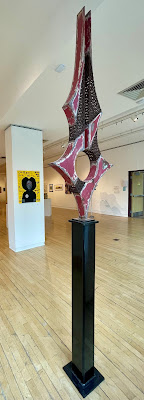 |
| William Fillmore's Red Warning #2; in the background is a painting by D. Colin photo provided |
Among the outstanding pieces to my eye and mind were the following:
 The exhibition’s other prize-winners are Royal Brown, for a
futurist reinvention of found objects; Jeff Wigman, for a Bosch-like painting
on wood panel, and William Fillmore, for a strikingly geometric steel
sculpture.
The exhibition’s other prize-winners are Royal Brown, for a
futurist reinvention of found objects; Jeff Wigman, for a Bosch-like painting
on wood panel, and William Fillmore, for a strikingly geometric steel
sculpture.The ACCR is open every day but Sunday; Fence Select 21 ends Saturday, Dec. 11.
 |
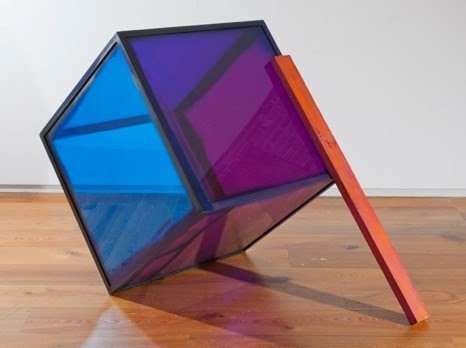
Installation view of Summer Bomb Pop at The Hyde Collection; from top, left are works by Myron Stout, Sarah Braman, Mindy Shapero, Robert Reed, and Steve Roden |
 |
| From left, works by Augustus Thompson, Bridget Riley, Richmond Burton, and Man Ray are grouped in Summer Bomb Pop all Hyde photos by Arthur Evans |
 |
| Sarah Braman - Fall Friend |
 |
| Four Greens, Upper Manhattan Bay, 1957 |
 |
| Front Street, 1978 |
 |
| Images des Antilles (Stephanie de Monaco) 1984 |
 |
| Four photo sequences by Eadweard Muybridge are shown with a painting by Henry Stull at the Museum of Racing |
 |
| A wooden hat form made in New York City |
 |
| An installer poses hats and hat forms at the Saratoga County History Center |
 |
| Nikolai Astrup, A Clear Night in June, 1905–07, oil on canvas: That Nordic glow |
This year, the Clark Art Institute in Williamstown, Mass., has
taken a different tack with its big summer show. Rather than feature a
blockbuster on the level of Renoir (2019), Van Gogh (2015) or Turner (2003), the
region’s most venerable museum has mounted the first North American show ever of
a little-known early-20th-century Norwegian painter named Nikolai Astrup.
Organized in collaboration with Norway’s KODE Art Museums,
and curated by British art historian MaryAnne Stevens, Nikolai Astrup: Visions
of Norway aims to convince its audience that Edvard Munch had an unjustly
overlooked contemporary who – perhaps - should be regarded as his equal. It’s
an intriguing and challenging argument to engage, and one that, in all honesty,
can’t be concluded – but, in the process, we are given a strong show that is
without a doubt well worth seeing.
 |
| The Parsonage, n.d, oil on canvas |
Gloomy – yet glowing. Despite his isolated circumstances and
shortened lifespan (he died in 1928 at the age of 47), Astrup burned with a
passion for his chosen subjects, the Norwegian landscape primary among them -
its particular light, its plants, its folk traditions, its rustic buildings,
and its people. This passion led Astrup to work feverishly, not just in paint,
but also extensively in Japanese-style woodblock printing (ukiyo-e), which he
executed extremely well, whether in multiple colors or in monochrome.
 |
| Bird on a Stone, woodblock print with hand coloring c. 1905–14 |
We learn from the concise wall text that Astrup was an enthusiastic horticulturalist, and we see evidence of that in the lovingly rendered trees, bushes, and flowers that pervade his works. No shade of green escaped his searching eye, but he also exercised plenty of artistic license in his renderings, in one case featuring identical rhubarb plants in two entirely different landscape views.
 |
| Rhubarb, 1911–21, oil on canvas |
In any case, the later work is indeed stronger overall, as
is particularly evidenced in repeated depictions of a Midsummer Eve bonfire
ritual that Astrup recalls from his youth, when his strict parents forbid him
to participate, as they considered it pagan. Several of these paintings and prints
are presented in the final gallery of the exhibition, making a clear concluding
statement about Astrup’s life, values, and skills as an artist.
 |
| Midsummer Eve Bonfire, before 1916, oil on canvas |
This is most apparent in some of the landscapes painted at
night, and in a couple of still lives made late in Astrup’s career in the
interior of his home. For me, though the subject is quotidian, private, and
momentary, the painter’s approach to it has taken it beyond those limits to the
universal and the eternal. Perhaps, had he lived longer, Astrup would have
followed this path to a place where the question of a revival would be moot.
But, whether he was truly a great modern painter, or merely
a talented also-ran, Astrup’s contribution is significant enough to be worthy of the
showcase he’s now receiving at the Clark and beyond.
Nikolai Astrup: Visions of Norway will remain on view in the special exhibition galleries of the Clark Center through Sept. 19; from October to May, it will travel to museums in Norway and Sweden.
 |
| Nikolai Astrup, Interior Still Life: Living Room at Sandalstrand, 1926–27 oil on canvas |
Two additional exhibitions currently on view at The Clark are also of great interest. Claude and François-Xavier Lalanne: Nature Transformed is an intriguing collection of Surrealist sculptural works by a non-collaborating French couple who each innovated with materials to create striking visions inspired by nature. It will remain on view through Oct. 31 in a glass-enclosed gallery on the ground floor of the Clark Center that also affords views of several pieces by the Lalannes that are installed outdoors.
 |
| Erin Shirreff, Four-Color
Café Terrace (Caro, –––––, Moorhouse, Matisse) 2019, dye sublimation prints on aluminum and archival pigment print |
In the café area downstairs in the Clark Center, and in the nearby Manton Research Center, are several large works by Erin Shirreff, a Canadian multimedia artist who combines sculpture and photography in unique ways. While her single long video stream and simplified photographic constructions are built with layers of references from other sources, they remain fresh, not derivative. Indeed, Shirreff's elegant abstractions are successful postmodern transformations and well worth spending some time with. The yearlong installation, entitled Erin Shirreff: Remainders, runs through Jan. 2.
Finally, Dürer & After, a new exhibition drawn from the Clark’s extensive holdings, is slated to open tomorrow (July 17) and remain on view through Oct. 3 in the Eugene V. Thaw Gallery for Works on Paper.
 |
| Ally DeRusso - father daughter dance |
The Opalka Gallery has always been slightly restless around the Photography Regional. The annual gathering of the photographic tribe has become something of a stepchild exhibition, hosted by a number of venues, each of which gives the show its own spin. In 2003, then-Opalka director Jim Richard Wilson organized the Photo Regional as an invitational, transforming what had been an open-call, juried exhibition into a curated one for the first time.
 |
| Natalia Gillespie - Abundance |
For sure, there are aspects of the exhibition that are earnest and derivative. But, as juried by Khidr Joseph, Jayana LaFountaine, and Anna Schupak, the show does not feel at all unseasoned. In its freshness, intelligence, and diversity, this year’s Photo Regional is hugely satisfying.
I’ve taught photography to undergraduates, and most were, as young people must be, possessed by themselves and their familiar surroundings. This is death to a photographer. Writers are taught to write what they know, but photographers cannot be nearly so interior. They must immerse themselves in what they don’t know - the unknowable realm of otherness that is the visible world. What they discover there becomes the foundation of their art.
 |
| Julia Larberg - Rainbow Self with One Leg Raised |
Often, though, when these young artists turn the camera on themselves, their interest is more persona than personal. Ally DeRusso enlists the 20th-century technology of the Polaroid instant camera for her set of five diptychs, casting herself in mini psychodramas narrated by enigmatic titles: smack you in the teeth, father daughter dance, and so on. This is the case too with Madison Scisci’s black-and-white video drama, The Release, in which she films herself in a dual role that leads either to reconciliation or liberation.
 |
| Mateo Guevara Lemeland - Neon Boneyard |
All the photographers in this year’s Regional came of age during the dystopian regime of Donald Trump. In those years, either the past was being rewritten 1984-style by the president’s henchmen, or rendered devoid of any coherent narrative or meaning. Constant exposure to historical gaslighting might have turned these young artists ahistorical, but it hasn’t. If anything, they are the captives of history, of political divisiveness, systemic discrimination, environmental degradation. In response, documentary photography provides some of the show’s most compelling moments.
 |
| Catherine Rafferty - A Nation that Forgets |
Other documents are more visceral. Anna Schupak takes us into the middle of a protest in her Troy series. In a pair of images, Catherine Rafferty juxtaposes the overheated red-white-blue of a Trump rally with the same palette in more somber tones. Her A Nation that Forgets places the blue dress and sandal of a black woman against red paint thrown like blood on the base of a public monument, where the inscription warns, “A Nation That Forgets Its Past Has No Future.” The “white” of the image is represented visually by the paleness of the cement plinth, and conceptually in the photo’s implication of racism.
 |
| Rainer Turim - Tompkins Square Park |
I admit I can make no sense of the arbitrary nature of the exhibition’s 16-26 age range, except to muse, somewhat cynically, that the aim was to attract high schoolers to Sage’s art programs. As it turned out, there is no one under college age in the show, the average age being about 22. (The only teenager is Xiaoxuan Lisa Li, whose tense, formal manipulations more than hold their own with the older exhibitors’ work.)
Rather than the weird high-school-to-post-MFA age swing, why not a more traditional “under 30” show, a range that allows for a greater number of mature emerging artists? The three jurors, all of whom are under 26, have given a hybrid feel to the exhibition they organized. While a call for entries opened the show to all, one suspects some of the artists were hand-picked by the jurors from among their friends and colleagues. The final selection feels more curated than the typical juried exhibit.
 |
| Xiaoxuan Lisa Li - Bat I |
These are serious questions but, ultimately, they should not
detract from the Regional’s comprehensive virtues: its quality, its
presentation, and above all its exhilarating diversity. In what has too often
been an exhibit of aging white dudes, this year’s 37 artists and 76 artworks
provide, in both surname and subject matter, a purposeful look across racial,
gender, and geographic boundaries. Yet the jurors’ obvious attention to
identity never overwhelms the individual artists’ voices.
 |
| Jahniah Kum - Resilience |
Singularly impressive are the “portraits” of six black sitters in Khidr Joseph’s Make Afros Great Again series.
Joseph gives us the backs of their heads, emphasizing their hair styles, and it’s enough. From this, we get a smart and sensuous alt-MAGA manifesto about black people’s hair and its fraught history of political and social meaning. The centuries of this struggle cannot be separated from the work’s visual beauty. Nevertheless, at a certain point, I surrendered entirely to the artist’s retinal stimulations - the pleasure of the textures revealed by his studio lights, and their kinship to the eros of color, of hair, flesh, fabric, even the chromatic seamless backgrounds. The “anonymity” of the sitters yielded to their uniqueness. The last and highest diversity is the inviolable individual.
Timothy Cahill has reviewed art in the Capital Region since 1995. He has exhibited his photography in the Photo Regional and other group and solo exhibitions. His work is in the collection of the Albany Institute of History & Art.
 |
| Khidr Joseph - Make Afros Great Again |
 |
| Juror Karen Davis peruses the Photo Regional Salon at Albany Center Gallery |
 |
| Laura Brodsky's fatherhood 2 won one of four top prizes at the Photo Regional |
First up, the 42nd Annual Photography Regional at Albany Center Gallery began on Sept. 8 with a salon-style installation of 200-plus submissions by more than 80 photographers. Karen Davis, co-owner of Davis-Orton Gallery in Hudson, then culled those submissions into a Select show that re-opened on Sept 18. It features 43 photographers (of which I am one) and includes 49 pieces, with 11 of those works receiving special recognition. Heads-up: The Photo Regional will close this Friday (Oct. 2), so you’ll have to hurry if you want to take a look. I recommend that you do.
 |
| Jill Baucom's Blackberries won one of four top prizes in the Photo Regional |
 |
| Amy Silberkleit - 1918 stone lithograph |
 |
| Deborah Zlotsky - Yours, Mine, Ours vintage scarves |
The largest of those galleries contains vast splashes of bright colors provided by works in many media – painting, sculpture, photography, collage, and textiles among them – with a large portion of those pieces being abstract. In a nearby, somewhat smaller room, again featuring the full array of media, the theme is landscape.
Yet another medium-sized gallery includes works that mostly engage in political or social commentary, again with many media represented but, in this case, weighted much more toward photography (not including my own, which are abstract, and hang in the larger gallery).
One feels the effects of 2020’s global and national upheavals in Cross’s selection of prizes, many of which went to the more topical works in the show, yet the overall effect of this Regional is what it should be: a well-distributed cross-section of the region’s best art, organized - but not dominated - by theme.
 |
| Jeff Wigman's oil on panel Arrival in Hell is included in Infinite Uncertainty. Wigman also has work in the Mohawk-Hudson Regional and the Fence Salon. |
It’s worth noting that seven of the 33 regional artists
included in Infinite Uncertainty are
also included in the Mohawk-Hudson Regional
(in which four of them received awards), an overlap that underscores the
meaningful relationship between the two shows. Like the Regional, Infinite
Uncertainty features work across many media, a good bit of it colorfully or
monochromatically abstract, but much more of it representing interpretive
responses to our current social issues.
 |
| Tatana Kellner - Scream collage, acrylic, and charcoal on paper |
Altogether, Infinite Uncertainty is a relatively rare instance of a carefully curated large group show at an urban Capital Region gallery featuring only regional artists. Though 33 seems like a lot of participants, the spacious gallery has enough room to accommodate multiple pieces by most of them, and numerous pieces by many, making for a great degree of depth in this presentation.
 |
| This mixed-media collage by Paula Drysdale Frazell is in the Fence Salon |
I will revisit the Fence
show on this blog after it has been juried and re-hung as Fence Select.
In the meantime, please do yourself a favor and get out to see these treasure troves of high-quality, current regional art while you can.
 |
| Mike Glier's oil on canvas Swallows Hunting is part of the Mohawk-Hudson Regional. Glier is one of three former Regional jurors who have work in this year's show. |
 |
Albrecht Dürer - Agony in the Garden (Christ on the Mount of Olives), 1508
detail of a print from the Engraved Passion series |
 |
Fall of Man from the Small Woodblock Passion, c. 1510
|
 |
| Joachim and the Angel from The Life of the Virgin, 1504 |
 |
Kykuit Estate, Tarrytown, New York
|
 |
Untermyer Park, Yonkers, New York
|
 |
Steve Gross and Susan Daley - Crane Estate, Ipswich, Massachusetts
|
 |
| A view of James Turrell's Into the Light at MASS MoCA |
 |
| Blane De St. Croix - Hollow Ground 2020 (seen during site-specific installation) |
 |
| Ad Minoliti - Fantasias Modulares |
 |
| Ledelle Moe - Remain at left; Congregation at right |
 |
| Justin Favela - Popocatepetl e
Iztaccihuatl vistos desde Atlixco, after Jose Maria Velasco, 2016 |
 |
| ERRE - Orange Country |
 |
| Wendy Red Star - Medicine Crow |
 |
| An example of a James Turrell hologram |
 |
| A view of James Turrell's Into the Light at MASS MoCA |


 Posts
All Comments
Posts
All Comments


