Get Visual is the grateful recipient of a grant from The Christos N. Apostle Charitable Trust
Showing posts with label basketball. Show all posts

Thursday, November 10, 2022

Running at 64

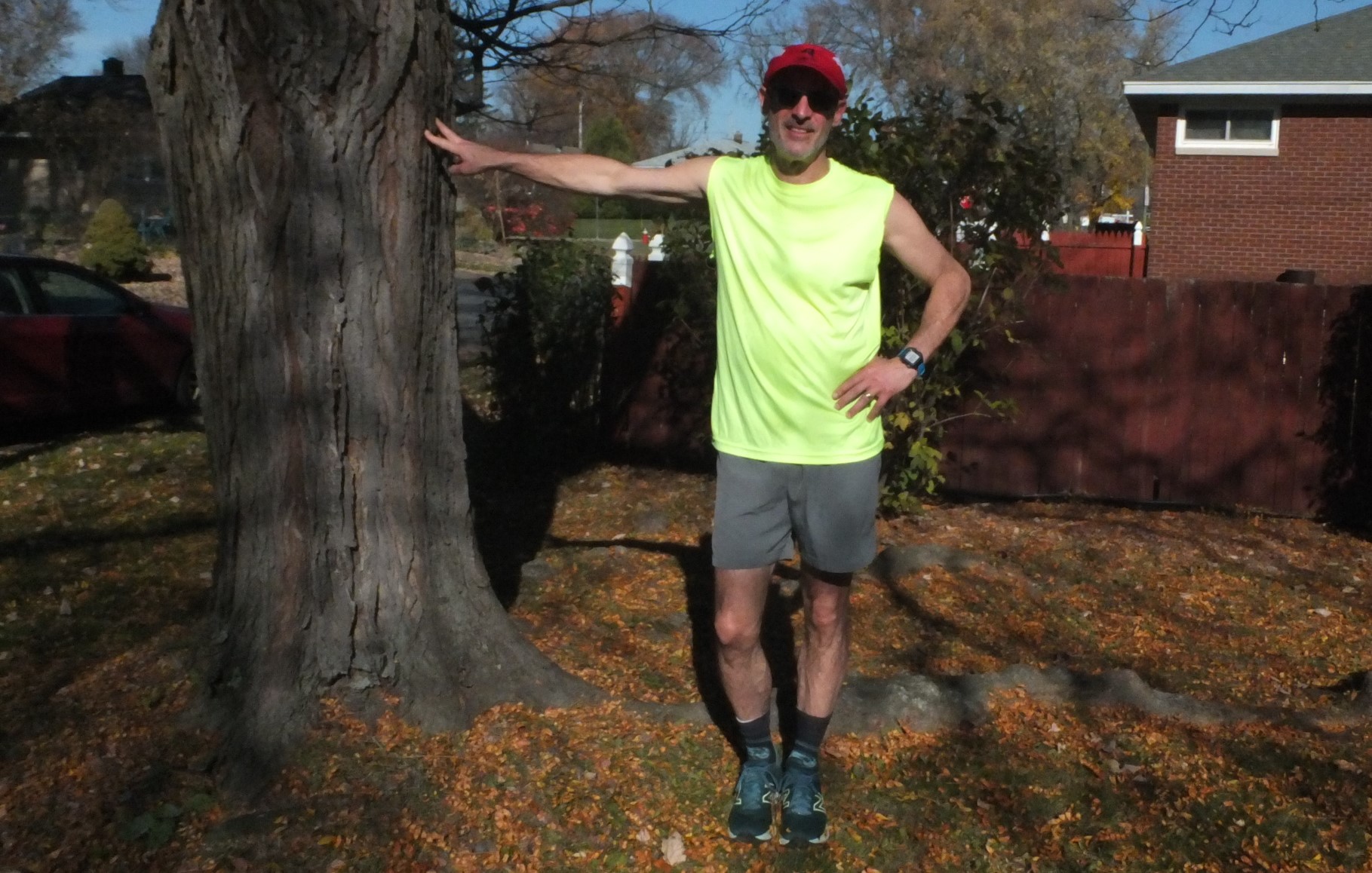
Last outdoor run of the year: Struggling a bit, but still holding up (a tree)
photo by Dick Bennett
Well, it looks like ol’ Father Time has begun to catch up with me, making this year’s running season a bit of a setback. For a couple of months I was plagued by minor injuries – or perhaps they are better called “conditions.” Left-hip sciatica that made half of my leg numb (hard to run when your leg can’t feel), a nagging pain in my right big toe (arthritis, gout, or a strained tendon?), and the occasional basketball-induced sprained ankle conspired to reduce my usual training to a mere trickle for most of the summer.

Before all that first-world agony, I had an OK start to the season, running my usual slate of 5k races in April, May, and June at a reasonably decent pace for springtime. That amounted to one race each month, with two top-three age-group finishes being the results, more or less in line with past years.

Finishing the Dunkin' Run 5k in 28:19
photo by Joe Putrock
But then the problems began, and I struggled to recover – though I’m glad to report some minor success in the end, with moderately acceptable showings in my last two races of the season. That included a surprising 2nd-place age-group finish in my home race, the Dunkin’ Run 5k, for which I received a rather ugly medal – a fitting representation of the overall season, during which I never broke 28 minutes for a 5k, a mark that was so routine just a year ago as to be unremarkable. Now, all at once, it’s unattainable.

But that’s OK. I’ve seen age suddenly overtake many of my senior-league basketball cronies, when guys in their sixties and seventies who for decades have appeared impervious to wear and tear seem to lose their sharpness and skill almost overnight. You never know when it’s going to hit, or how hard – but it absolutely will come.

This awareness of the universal fragility of our mortal body has made me that much more grateful that I still can get out for a good run on a beautiful fall day, and can still walk onto (and off of) a basketball court under my own steam. Cherish those moments!

And I truly do … with hoops season in full swing, my team is off to an impressive 6-1 start, and my injuries (for now) have subsided, leaving me able to play at my best most of the time. Though it’s not the same as a beautiful long jog in the open air, it’s still a good run, with all the attendant healthy benefits. As for racing: There's always next year!

On another note, somewhere amid the physical limitations of the summer, I managed to get up on water skis for a few minutes, which was terrific fun. It was the first time I'd tried that in at least twenty years, and will probably be my last, as I was sore for days afterward! Here’s proof of the feat, offered up for your amusement (video by William Laviano).

Hope you have a great fall and winter! See you next year. 

Friday, November 13, 2020

The Ivy League leads, again

It took a pandemic to make me proud to be a product of the Ivy League. I received my bachelor's degree in studio art from Brown University in 1979, but it was a bad fit, and I largely hated the place, only making it through thanks to a fully credited year at the Italian University for Foreigners and a lot of time spent at nearby RISD, where I took more courses than the allowable limit for Brown students and shared housing with some of those wacky art students.

But setting aside the proto-Gordon Geckos of my time at Brown, and the centuries of entitlement that have floated the elitists who typically graduate from Harvard, Yale, and the rest, this educational confraternity has led the nation twice in making the right call on shutting down its sports programs before the coronavirus itself had the chance to do the deed more brutally.

You may recall that the first sports league in the US to declare a full stop last March was the Ivy League.

It didn't matter that they were in the midst of their annual league basketball tournament, or that the NCAAs of March Madness fame and glory would be next - the great minds of those combined institutions (including the many top scientists on their faculties) knew it was time to mask up and hunker down. The next day the NBA followed suit, leading all the other college and pro leagues that then joined the inevitable months-long pause, one by one.

And, now, it's happened again, as the second wave of the virus is taking hold of the country, and the Ivies announced on Thursday that they are canceling all winter sports. This will have immediate local impact, as two of the mots popular teams in the Capital Region (Union College and RPI hockey) compete in the ECAC, a league that includes six of the seven Ivies (making up half of the total number of ECAC teams).

And, I predict, this is just the beginning. Like last spring, there will be more canceled sports seasons to come. Don't get me wrong - I don't celebrate the loss of healthy competition for collegians, nor the potential massive loss of revenue for the professional leagues if they also shut down again; neither do I applaud the disappointment to millions of fans who need the distraction of sports entertainment now more than ever.

And I am truly grateful for the mid-pandemic professional sports seasons that were recently completed - somehow, almost miraculously, without widespread illnesses or deaths - including baseball, soccer, hockey and, my favorite, basketball.

But it is starting to look like madness to try to continue the NFL season, or to resume the NBA, etc., if things don't turn around very soon. I've no doubt that the great minds that run these leagues are currently consulting with the great minds that know the science - many of them educated at or teaching at Ivies - and that they will come to the right conclusions that will keep athletes, coaching staffs, and fans safe.

In the meantime, stream a good movie, read a good book, eat some good takeout with carefully vetted family and friends - and take good care.

Tuesday, August 18, 2020

It's the NBA playoffs!

NOTE: On Wednesday, August 26, players for the Milwaukee Bucks sparked a widespread protest of the shootings in Kenosha, Wisc., among major league teams, resulting in the postponement of that day's NBA playoff and WNBA games, as well as several Major League Baseball games. The NHL followed suit the next day. Some NFL practice sessions also were canceled.

As of Friday, August 28, those leagues were planning to resume play, based on the players' decision that it would be more effective to continue to use the high-profile platform of their televised games to promote the cause of social justice and racial equality than to go on strike.

I stand in support of the protesters in placing the need for change above the desire for sports entertainment (see the Bucks players' statement here). The following content of this post remains as I originally wrote and published it on August 18. - DB.


LeBron James of the Los Angeles Lakers and Giannis Antetokounmpo of the Milwaukee Bucks are the two best players in the NBA, and their teams each topped their respective divisions going into this season's playoffs. Will they meet in a Finals series set in October for the first time ever?
Close readers of this blog will recall that, from time to time, I write about basketball, and I can't resist the opportunity to celebrate publicly the successful return this summer of the NBA inside its Florida bubble.

I've always liked this league for its solid leadership, respect for players, and willingness to adapt to change, and the coronavirus pandemic provided further support for that opinion. The league was the first at the pro level to announce a shutdown (following the even more impressive leadership of the Ivy League, which pulled the plug before anyone else in sports), and it has been the clear United States leader in figuring out how to come back safely.

With a severely shortened season, the NBA's eight-game-per-team "seeding" round proved to be a total blast, with terrific technical innovations, stunningly competitive games, and no COVID outbreaks. I only caught a few of those games, but they were all highly entertaining, due in part to the "virtual" fans shown live on mega-screens surrounding the courts (imagine a Zoom meeting on steroids) and in part to the virtual silence, which allowed the TV audience (not to mention players and coaches) to hear the on-court patter.

The culmination of this phase of action was a fabulous "play-in" game, the first of its kind ever in the league, in which Portland and Memphis battled to a last-minute victory by the Blazers, placing them first in line to confront the league-leading Lakers in the first round of the playoffs, which began this afternoon. Portland's late run to the final seed included three consecutive games in which its star player, Damian Lillard, averaged 51 points a game. That's right, averaged.

I should also mention the classy and effective way the league has handled the urgent issue of Black Lives Matter within the context of presenting entertainment in the form of professional basketball, by establishing a long list of slogan options for players to wear (or not wear) in place of their names on the backs of their uniforms. For the first week or so of games, these slogans appeared above the number with no player name shown at all, underlining the players' desire to place this issue above their own egos. Later, the players' names were added below the numbers, while the slogans remained in the top position (I don't know if this was planned or an afterthought - I will say that it helped me identify who was who on the court, so it may have come from popular demand).

I liked a lot of the slogans, and it was interesting to think about the choices each player made - for example, a younger, brasher guy might wear "I Am A Man," while a lot of the older guys opted for "Peace" or "Education Reform." "Black Lives Matter" and "Equality" seemed to be the most popular choices - with "Equality" appearing in several different languages on foreign players' jerseys (I observed and then confirmed Serbian, Latvian, Slovenian, German, and Italian among them).

Most interesting of all was "Group Economics," touted for the approved list and then worn by Grizzlies forward Anthony Tolliver, along with a couple of other players (and quite adequately explained here). This level of educational opportunity just doesn't normally come with major league sports, and I loved seeing it as part of every game.

Meanwhile, throughout the league, there are so many stars vying for a Finals ring that fans can rightly expect plenty of fierce competition and outstanding play in the weeks to come - with no risky travel, clear and strong controls in place, and what appears to be little likelihood of COVID-related issues (unlike, ahem, MLB).

My hat's off to the NBA, its administrators, coaches, and players for having the ability to pull this off together. And may the best team win.

Sunday, January 7, 2018

The Patroons are back!

A view of the Washington Avenue Armory during Saturday's game
photo by my old buddy Hans Pennink, stolen from the Times Union
Good-sport spouse and I attended the home opener of the new Albany Patroons professional basketball team on Saturday, and we had a great time. Like the glorious Patroons of old (circa 1980s), this team plays in the Washington Avenue Armory, a well-lit venue with character, history, and a quite good-looking hardwood court.

While technical difficulties marred the franchise's North American Premier Basketball League debut (i.e. no scoreboard or shot clock, and a truly insipid buzzer), it was still a pretty successful launch, with an announced crowd of 1,507 and a solid win for the home team. One of the beauties of the Armory, and the source of its legendary intense atmosphere of past Patroons success, is that it's small enough so even 1,500 people can warm it on a frigid night, and 3 or 4 thousand will positively rock the place. I don't think even the most optimistic boosters expect such numbers any time soon (or ever), but I do think the quality of the experience has the potential to draw healthy crowds if management can work out the kinks.

Coach Rowland directs his team
Hans Pennink/TU
Meanwhile, the legacy is alive in the form of Head Coach Derrick Rowland (aka Dr. D), a stalwart team member in the Pats' heyday, and one of the top players in the history of the old Continental Basketball Association that fostered the original franchise. Rowland leads a crew of athletes with a range of professional and college playing experience who delivered a very entertaining game, replete with speedy play, smooth long-range buckets, and rim-rattling dunks.

After a raggedy first period in which the Rochester RazorSharks seemed to have the upper hand, especially on defense, the Pats gathered themselves and, by the start of the third period, had gained a lead they did not relinquish. The play was fast and physical, the officiating was iffy (though spiffy, uniform-wise), and the player rotation allowed every starter and bench-warmer plenty of opportunity to make a strong first impression on expectant fans.

I attended just about every home game played by the champion Patroons of old, and I'm not about to say that this roster could compete with the likes of Tony Campbell or Mario Elie (to name two of many former Pats who went on to have significant NBA careers), but I was not at all disappointed by what I saw on Saturday. Among the standouts, ex-Los Angeles Laker Smush Parker ably led from the point, rocketing some beautiful passes along the way; rangy forward Torren Jones earned my respect, and a double-double, with great play in the paint; and local hero Lloyd (Pooh) Johnson buried several threes to help ice the game. And that's without currently sidelined Siena product and 2012 NBA D-League Rookie of the Year Edwin Ubiles, who should prove to be among the team's best players when his back feels better, and former Patroon Jamario Moon, a crowd-pleaser with scads of NBA and international hoops cred, whose presence will help to sell more seats if they can convince him to sign on.

So, I'll be back, with high expectations, and the hope that this thing gets some traction and regains a little bit of the old glory - or at least brings back the crazy fun of a filled-to-the-rafters Armory vibrating in the Albany night.


Sunday, March 20, 2016

Bring on the Madness!

Players for the #15 seed Middle Tennessee State basketball team celebrate
their first-round upset of #2 seed Michigan State in the NCAA tournament.
photo from USA Today
Those who know me know I am crazy about basketball.

Not so much as a fan: First, I'd rather play than watch; second, I don't follow any particular team; and, unlike about half of the American population, I have never filled out a bracket.

But then there is March Madness. Even the most casual observers can't avoid the annual fever that overtakes the country, as NCAA basketball goes all out for its national tournament, and everybody is talking about Cinderellas, dynasties, and bracket-busters.

Recent years have seen the Madness get better and better, as lesser-known programs build success on the regional level and then shock the college hoops world with surprising runs to the second and third rounds of the tournament (or beyond). Despite the politics behind selection and seeding, and the inherent unfairness of the bracket system that always pits the highest-ranked teams against the lowest-ranked ones, parity and upsets are becoming wonderfully common.

Sports at this level are always fun to watch, whatever the game, because you see top talent giving it their very best for high stakes. The built-in drama of the madness of March adds emotion and excitement to the experience, and generates great stories. For me, whether it's hockey, soccer, golf, tennis, or baseball - men or women - playoff sports are always worth watching (even football, which never quite holds my attention otherwise).

But hoops is the best. And here's why:
  1. Constant action (also offered by hockey and soccer)
  2. A lot of scoring (the lack of which is the chief drawback of the other two sports named in #1)
  3. Whole team involved in almost every play
  4. All players must contribute on both offense and defense
  5. Time pressure
  6. Skills, skills, skills (you can specialize in basketball, say as a three-point shooter, but nowhere near as much as in baseball and football)
  7. Sheer athletic ability (ever seen a hoopster with a huge gut?)
As I am a reluctant TV viewer (who, by personal decision, watched none at all from 1971 through 1984, and have never subscribed to cable), it takes a lot to make me sit on the couch for more than a half-hour - something like Breaking Bad, or Downton Abbey - but I'll sit there today for hours, just as I did yesterday and the day before, and the night before that getting way too little sleep for a proper Friday at work, and I'll do it again next weekend, and so on. Until the Madness ends.

Because it's that good.

Monday, February 9, 2009

The Albany Patroons, and other loose ends

Although basketball is not a visual art, I am a fan and a player, and I am very happy to be able to say that I attended what was very possibly the last game ever for the Albany Patroons and the Continental Basketball Association (CBA) on Sunday night at the Washington Avenue Armory in Albany.

But first, for you art lovers, here's an aside worth pursuing:

A photographer I know, Bill DeLanney, has a show at Fulton-Montgomery Community College that is nicely introduced in this blog entry by former Gazette colleague Bill Ackerbauer:
http://www.leaderherald.com/page/blogs.detail/display/276.html

I first met DeLanney several years ago when, still new at this, he came to me for a critique. I loved his work then, and now so does just about everybody else (such as restaurateur Angelo Mazzone, who filled his Aperitivo dining rooms with DeLanney photos). I haven't seen the show at FMCC, but it will surely be as strong as everything else DeLanney does. Check it out if you can; it's there through March 13.

And now back to the Patroons.

My enthusiasm for Albany's professional basketball team goes back to the '80s, when I had a gallery not far from the Armory and began attending games after work. The team had a run of great years back then, in which a number of players went up to the NBA (one, Mario Elie won multiple NBA championships post-Patroons, including one as a starter with the Houston Rockets) and a string of three coaches also became NBA stalwarts (the late Bill Musselman, George Karl and Phil Jackson).

In those days, the Armory regularly packed in upwards of 4,000 people for games, and the place literally rocked. While last night's attendance was announced at a perhaps generous 1,788, there was still enough energy in the house to bring back a taste of the good old days, and the Patroons fed off the crowd to mount a strong comeback to nearly win a terrifically tough game. Instead, they went down fighting, losing the championship-deciding game 109-107 in overtime to a very talented Lawton-Fort Sill Cavalry team.

It was a great show for a die-hard group of fans - and, I hope, not a swan song for professional basketball in Albany or for the CBA as a whole. For an excellent full report on the game by the Times Union's Tim Wilkin, go to http://timesunion.com/AspStories/story.asp?storyID=768243&category=SPORTS.

And now, back to art. Last week, I rode down to New York with my friend John Hampshire for his second exhibition at Chelsea's Phoenix Gallery (http://www.artinfo.com/galleryguide/20133/6671/120007/phoenix-gallery-new-york/exhibition/vimala-steadmanjohn-hampshire/). Because John is a friend, I will not be offering a critique of the show - but I can say without conflict that he is one of the regional artists to watch, and his work at Phoenix is a good example of why that is. John employs a mind-bogglingly complex system of markmaking (in both black-and-white and color) to create images that are both peculiarly abstract and highly realistic. He presents one color painting and four black-and-white drawings in this show, through Feb. 28.

Another exhibition I saw on this trip was a total knockout: Recurrence: Aaron Siskind at Bruce Silverstein (http://www.brucesilverstein.com/) is a tour-de-force of exhibition design that features a dazzling array of vintage Siskind prints in several rooms that make the most out of Siskind's full black-and-white palette (shown: Vermont 1987, four gelatin silverprints).

The work is presented in groups, some in a grid arrangement, some stacked or lined up, but always to great effect in keeping with the show's intention of exploring the theme of recurrence in Siskind's work.

The pictures are all matted in white, but the framing color varies from group to group - some are white, some a lighter shade of grey, some a darker shade of grey and some black. Also, the gallery's walls are variously painted white and shades of grey to complement this presentation, and it works extremely well.

I comment on the design of the show, because too often a strong collection of work fails to connect with me as a viewer because of insufficiently thoughtful presentation. It is also possible to go too far, getting cute or overbearing with labels and such; so I really appreciate and commend a gallery when they know how to do it just right. This was my first visit to Silverstein, but it surely won't be the last. The show has been extended through March 7, as has the concurrent exhibition by Shinichi Maruyama, which I also wholeheartedly recommend.