Get Visual is the grateful recipient of a grant from The Christos N. Apostle Charitable Trust
Showing posts with label mixed-media. Show all posts

Thursday, March 3, 2022

Short Take: refract at Albany Center Gallery

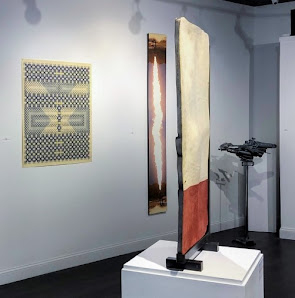
Works by, from left, Royal Brown, Naomi Lewis, and Benjamin Jose
are part of refract at Albany Center Gallery.
photos provided

The five artists in Albany Center Gallery's current show, refract, don't appear at first glance to belong together. Their media vary from video to watercolor to cast iron; their imagery from space-age to delicacy on the page. But a theme does emerge from the selection, which was organized by the gallery's associate curator, Jennie Tang. It has to do with the approach these artists take to their subjects.

Owen Barensfeld's Is It big Enough?
combines images to make a statement
This concept is best explained by the gallery's written material, which states that the five artists employ "different methods of repetitions, patterns, juxtapositions and distortions" to broaden our understanding and experience of everyday visuals. Here, those visuals have become abstracted and transformed, built of mere suggestions, or created directly out of the simplicity of a grid.

The show, like many at this venue, is spare, featuring just 29 works in all. Nine of those works are by Naomi  Lewis, whose whisper-soft graphite drawings pull you in close, and whose patterned images of bees fill their surfaces expansively, often emphasizing negative space to great effect. Equally wed to overall pattern, Trevor Wilson painstakingly builds large images out of tiny squares in grids of graphite or colored pencil, the results feeling almost equal parts human and machine.

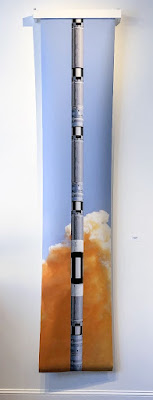
Owen Barensfeld and Royal Brown come from opposite positions to meet in a middle zone of spaceships and technology. While Brown creates colorful models of imaginary craft out of the most mundane of found objects (empty spray cans and such), Barensfeld transforms mass-media images of bomb blasts and moonshots into objects of contemplation. Both have something to say: In Brown's case, it's a literal message of love amid fantasy; Barensfeld's seems to be more about the mesmerizing terror of industrial power.

From left, works by Trevor Wilson, Owen Barensfeld,
Benjamin Jose, and Royal Brown are part of refract
Benjamin Jose seems to be the odd man out in this group. His constructions of mismatched materials struck me as being more in the realm of formalism and surrealism than anything else here, and his messages less clearly stated than the others'. That said, his highly refined use of such disparate substances as wood, steel, and leather holds its own kind of fascination.

refract will remain on view through Friday, March 4, so it's now or never if you want to catch a look. I'm glad I did.


Wednesday, January 12, 2022

Pieced Together at APL

Henry Klimowicz - Large Collections of Like a Lichen #2
cardboard and glue 2021
Perhaps one of the best-kept secrets on the local gallery scene is the Pine Hills Branch of the Albany Public Library, where expertly curated exhibitions of regional artists have been mounted about twice a year for quite some time.* And the current show, Pieced Together, is one of the best yet.

Organized by staff at Russell Sage College's Opalka Gallery, Pieced Together features 11 artists united by the theme of assemblage, an often overlooked art form that came into its own during the height of Modernism, in particular among Dadaists, often in the unassuming clothing of paper collage. Most of the work in this show follows fairly closely in that tradition, while some of it feels more connected to later periods of contemporary art that grew out of Modernism.

Altogether, this is a particularly lively collection of very accomplished work by well-established local favorites and a few relative newcomers, including one recent Sage graduate, Chloe Harrison, whose delicate matboard constructions show promise, while confirming her self-described fledgling status.

Beth Humphrey - Mutual Aid, 2020
spray paint, gouache, crayon, film on paper
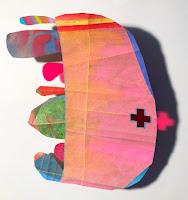
Highlights from the show are many, even if one must perform something of a treasure hunt to find them all in the two-level space which, though not designed for art exhibitions, still serves well to showcase the work. Installations here always exploit the big central staircase, this time featuring two of my personal favorite artists of recent times: Beth Humphrey, who presents a constellation of small framed works on a mid-level wall that delight with their shapes, colors, and layerings; and Kenneth Ragsdale, who offers a suspended wire laden with playful, oversized folded-paper objects from his own quirky personal vocabulary of memories and imaginings.

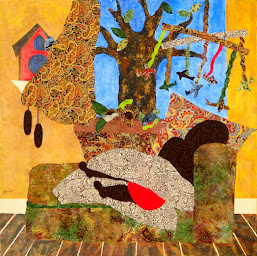
Paula Drysdale Frazell - Nap Time, 2015
acrylic paint and fabric on canvas
Another recent favorite artist, and one who I think deserves - and will get - more attention as time goes by, is Paula Drysdale Frazell. Her mixed-media works are less related to cut-paper collage than they are to painting and, in a sense, quilting, as they combine paint, fabric, and printed paper (such as maps) in colorful and playful compositions that draw from childhood memories and other family stories. Her works are both charming and thought provoking, making for a tricky balancing act that she handles comfortably.

Three of the artists in this show are strictly collagists of the cut-and-paste variety, forming a core for this selection, and being easily appreciated by any of us who have ever tried that medium (myself included); they are Niki Haynes, Juan Hinojosa, and Michael Oatman, all of whom have appeared in other local shows recently, and whose work remains fresh and fun.

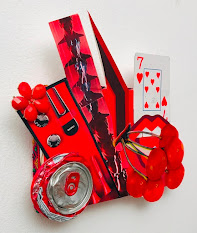
Juan Hinojosa - Lava, 2020
mixed media on panel with plastic,
soda can, wall paper, jewelry, ribbon
Hinojosa is easily the flashiest of this group, delving into consumer culture with abandon, embracing the brightest of colors and materials and, in the case of two works in this exhibition, utilizing metallic surfaces as a background. Eye-catching, to be sure, but for my taste a bit superficial.

Haynes, in contrast, hews to the mystical. Here, she presents a group of six small collages that coolly spook you with eyes that are watching from on high. Her technique is almost alarmingly simple, but it takes a lot of experience to get to simplicity and have it work so well, and Haynes has it.

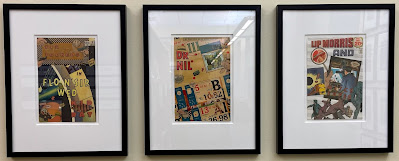
Oatman throws us a curveball by installing a body of 26 comic-book collages he made in 1983, during the summer after his first year in college. I'd glimpsed these somewhere before, and was delighted to see them again, as they are witty, well crafted, and totally consistent with the work he is making today, nearly 40 years later. It takes courage to reveal early work, and in this instance I think it pays off.

The other artists in the show, which opened on Oct. 1 and will run through April 17, are Fern Apfel, Danny Goodwin, Henry Klimowicz, and Melinda McDaniel.

*Full disclosure: I recently joined the board of directors of the Friends and Foundation of the Albany Public Library, which has some input into programming at the branches, including arts programming.

Michael Oatman - three examples from the collage series A Boy's History of the World in 26 Volumes (+1), 1983
photo by Michael Oatman


Thursday, April 8, 2021

Jamie Rodriguez at the ACCR

Totenkopf, Die Werbung, The Invisible Enemy - installation by Jamie Rodriguez
Jamie Rodriguez is one of the more interesting artists to have emerged on the local scene in the last decade or so, and his current solo exhibition at The Arts Center of the Capital Region in Troy is a well-earned showcase of his latest work.

A frequent prize winner in the annual Mohawk-Hudson Regional, Rodriguez has distinguished himself with challenging, multilayered installations that combine painting, drawing, and sculpture, often to a confounding effect, and this show, entitled Warenfetischismus: Commodity Fetishism is no exception.

Montserrat Landscape #1
oil paint on canvas 2019
I noticed from the first time I saw his work that Rodriguez is a very skillful painter, and this exhibition showcases that aspect of his art by featuring 15 oils on canvas, most of them sun-washed landscapes in an Impressionist style that clearly evokes Cezanne and Van Gogh. The four large mixed-media installations that comprise the remainder of the show all incorporate similarly executed paintings, a stylistic innovation I don’t recall having seen employed by any other artist.

So, labels aside, Rodriguez is a creator who ably applies whatever materials he needs to make his statements – and those statements are ambitious, on a global scale. These installations evoke international politics, with references to Nazi Germany, Soviet Russia, Communist China and capitalist America; environmental issues, including water shortage, habitat loss, and pollution; economic matters such as the commodification of food; religion, via icons and altars; and historical references in the form of architectural elements, decorative tilework, and weaponry.

Argumentum ad baculum, (Fact Check:
To The unhinged and useful idiots, the
Revolution has been canceled as part of
culture, No Justice, No Peace for Wendy's,
The Rubicon has been crossed) -
2021
(detail view of installation)
The last item is perhaps the crux of this work, which openly concerns itself with war and conquest. But the naturalistic concerns are also central, as Rodriguez deploys multiple animal figures - foxes, lambs, raccoons, and various rodents among them - as avatars. His statement accompanying the show offers clear insights into his intentions, while welcoming viewers to make their own interpretations of the work. In part, it says: These narratives can draw attention to many different topics, that can be interpreted in any way the viewer connects … I want to evoke emotion and awareness of the individual to confront the issue of how art functions within a particular set of social and cultural patterns, historical perspectives, and belief/faith systems, while maintaining a sense of humor and humility.

That’s a lot to pack into any work of art, and Rodriguez gives it a good shot. My overriding response to this show is that it has a potent sense of urgency. The sprawling, highly detailed tableaux incorporate a great many carefully constructed elements, which undoubtedly have taken a lot of time to create, yet they still feel improvised, even slapdash in a way, as though the artist feels too pressed to add even the slightest extra bit of finish to his product. Only the paintings appear polished, serving as a counterpoint to the roughly representational sculptures into which they are integrated.

It’s enough to make you breathless.

Warenfetischismus: Commodity Fetishism - Artworks by Jamie Rodriguez will remain on view through April 16.

Polarity Integration: The Universal Game, Zwischenzug, Spiritual Algorithm, end game-"Transcension", Think, Think Tank? Paradigm Shifts
mixed-media installation by Jamie Rodriguez, 2021


Sunday, March 7, 2021

Earthly at Esther Massry Gallery

An installation of numerous works by Julie Evans is the focal point of Earthly
all photos provided

The current five-person show at The College of Saint Rose's Esther Massry Gallery in Albany is a lively, cohesive example of curatorial ingenuity.

While each artist in the show is highly skilled and clearly worthy of attention on her own, in this setting the five women's works take on greater complexities of meaning through their interrelationships, losing nothing of individual strength in the bargain. The theme of the show, which is entitled Earthly doesn't shout - in fact, it's so subtle you could miss it altogether - but it succeeds in holding the collection together organically.

Odessa Straub - Supplemental Soul Suppository 2019
I don't have a favorite in this show, though I'd say the layered, lyrical installation of nine ink-on-Mylar assemblages by Julie Evans is its focal point. Dated 2011-2014, these mixed-media organic abstractions retain their freshness, enhanced by the playful nature of their presentation here, in which an unframed series of swooping and morphing forms adhered directly to the wall serves as a lattice to connect the more stolid framed and mounted works.

Also installed directly on the walls are three of four sculptures by Odessa Straub (the fourth being a freestanding floor piece). Straub has a Surrealist bent, with a Dadaist sense of humor and surprise. How else could one so elegantly combine such inapt objects as a live underwater plant and a leather speed bag (the type used by boxers to train), among other witticisms? There's also an undercurrent of mad-scientist menace to Straub's combines, while they are still sleek, playful, and colorfully pleasing.

Meg Lipke - Garden Gates II 2020
Meg Lipke also works in three dimensions, but her two pieces in the show play off the wall as pumped-up frames that become their own pictures. Lipke's more modest piece (which is untitled) has multiple openings in a pillow-like structure of stuffed fabric, with highly vivid coloration activating its upbeat claim on a small square of wall space. Her much larger Garden Gates II, also made of painted stuffed fabric, is less bright and slightly droopy - but, at nearly 9 feet tall, its presence is clearly stated.

Yet another sculptor, Tamara Zahaykevich, is represented by a group of five pedestal-mounted forms that hold together quite nicely as a group, though they span well over a decade of production from 2007 to 2021. Like Evans' work, these lean toward abstract biomorphism, with a limited color palette and carefully worked surfaces.

Two Tamara Zahaykevich sculptures
Variety comes as Zahaykevich works these pieces' surfaces in many different ways, from meticulously detailed to roughly scrubbed. One piece, entitled Robert Wisdom is more architectural, as were some of Zahaykevich's pieces that were included in the excellent Cut and Color show that recently ended at the Albany Airport Gallery.

The overall installation of earthly is somewhat sparse, which allows for one side of the gallery to remain unlit for viewing the wall-projected video contributed by Laleh Khorramian. Entitled I Without End, the nearly 7-minute-long time-lapse animation is a curious vision of sad romance, played out by carefully cut orange peels in a miniature chateau-like setting.

Khorramian's soundtrack ranges from lightly industrial to orchestral, including atmospheric voices at times, and it sits comfortably in the gallery space, not loud, almost soothing. Her imagery is at turns abstract and representational, but its real magic comes in the unpredictable movements of drying organic material over time, and it is surprisingly affecting. I don't have a lot of patience for longer-running video clips in a gallery setting, but this film held my attention for two complete viewings.

Credit is due the two curators of Earthly, Saint Rose Associate Professor of Art Susan Meyer and Massry Gallery Manager Erin Sickler, who've assembled this grouping with sharp eyes and clear minds, allowing the whole to honor each of its parts. The show will remain on view through March 17.

A still image from Laleh Khorramian's 2008 animation I Without End 

Tuesday, September 29, 2020

Regionals, regionals ...

Juror Karen Davis peruses the Photo Regional Salon at Albany Center Gallery
Thanks in part to the coronavirus pandemic, we now have a perfect storm of regional exhibitions that are all on view simultaneously. With three annual juried shows having been rescheduled, and a new lockdown-themed juried show now open at a prominent college gallery, it’s a boon to regional artists and their fans.

Laura Brodsky's fatherhood 2 won one
of four top prizes at the Photo Regional

First up, the 42nd Annual Photography Regional at Albany Center Gallery began on Sept. 8 with a salon-style installation of 200-plus submissions by more than 80 photographers. Karen Davis, co-owner of Davis-Orton Gallery in Hudson, then culled those submissions into a Select show that re-opened on Sept 18. It features 43 photographers (of which I am one) and includes 49 pieces, with 11 of those works receiving special recognition. Heads-up: The Photo Regional will close this Friday (Oct. 2), so you’ll have to hurry if you want to take a look. I recommend that you do.

Jill Baucom's Blackberries won one of
four top prizes in the Photo Regional
Also recently opened, on Sept. 19 (through Jan. 3, 2021), is the 2020 Exhibition by Artists of the Mohawk-Hudson Region (aka the Regional), which is the most significant show in the annual calendar locally and, now in its 84th year, one of the longest-standing shows of its kind in the nation. The Regional rotates among three venues, and is hosted this year by the Albany Institute of History & Art, which tapped MASS MoCA Senior Curator Susan Cross as juror. In keeping with Regional tradition, an accompanying catalog with an essay by Cross is planned by the Institute and will be available in a few weeks.

Amy Silberkleit - 1918 stone lithograph
Perhaps due to Cross’s high profile as a curator in the region, the show attracted more than 700 entries by nearly 250 artists across all media. Cross whittled these down to 108 works by 73 artists (of which – you guessed it – I am one), also selecting 19 among them for special awards that range from $1,000 cash to $100 gift certificates. She then planned the installation of the show in five contiguous spaces within the museum, using the variously sized galleries as venues for thematic groupings.

Deborah Zlotsky - Yours, Mine, Ours
vintage scarves

The largest of those galleries contains vast splashes of bright colors provided by works in many media – painting, sculpture, photography, collage, and textiles among them – with a large portion of those pieces being abstract. In a nearby, somewhat smaller room, again featuring the full array of media, the theme is landscape.

Yet another medium-sized gallery includes works that mostly engage in political or social commentary, again with many media represented but, in this case, weighted much more toward photography (not including my own, which are abstract, and hang in the larger gallery).

One feels the effects of 2020’s global and national upheavals in Cross’s selection of prizes, many of which went to the more topical works in the show, yet the overall effect of this Regional is what it should be: a well-distributed cross-section of the region’s best art, organized - but not dominated - by theme.

Jeff Wigman's oil on panel Arrival in Hell is included in Infinite Uncertainty.
Wigman also has work in the Mohawk-Hudson Regional and the Fence Salon.
Fortunately, another local gallery took up that thematic challenge by specifically requesting topical work for an open-call show juried by Sharon Bates, Stacey Robinson, Ellen Letcher and Julie Torres. Infinite Uncertainty opened at Sage College of Albany’s Opalka Gallery on Sept. 1 and includes approximately 100 works selected from over 250 total submissions. It closes on Oct. 10 so, again, you’ll have to hurry if you want to see it - and I recommend that you do.

It’s worth noting that seven of the 33 regional artists included in Infinite Uncertainty are also included in the Mohawk-Hudson Regional (in which four of them received awards), an overlap that underscores the meaningful relationship between the two shows. Like the Regional, Infinite Uncertainty features work across many media, a good bit of it colorfully or monochromatically abstract, but much more of it representing interpretive responses to our current social issues.

Tatana Kellner - Scream
collage, acrylic, and charcoal on paper
Each artist’s work is accompanied by statements that explain the impetus for the selected pieces, ranging from technical adaptation to using available quotidian materials during art-supply-chain shutdowns to direct commentaries on hot topics like the pandemic and BLM protests. The writings provide a telling window into the interior lives of artists, and make a strong statement about both their resilience and the power of art to buoy the human spirit in hard times.

Altogether, Infinite Uncertainty is a relatively rare instance of a carefully curated large group show at an urban Capital Region gallery featuring only regional artists. Though 33 seems like a lot of participants, the spacious gallery has enough room to accommodate multiple pieces by most of them, and numerous pieces by many, making for a great degree of depth in this presentation.

This mixed-media collage by Paula
Drysdale Frazell is in the Fence Salon
Finally, the Fence Salon show opened on Sept. 11 at the Arts Center of the Capital Region in Troy and will remain on view there through Nov. 7, after which it will be rehung as the Fence Select, which will be juried by Tang Museum Director Ian Berry. Please note that the Arts Center is operating on a modified schedule – open Tuesday to Thursday, 10 a.m. to 2:00 p.m. or by appointment.

Here, too, there is significant overlap with artists who are also in the Mohawk-Hudson Regional (I counted nine), which comes as no surprise considering the prestige of the juror and the longstanding tradition of this show, which I have often referred to as “the other Regional.” There’s also some artist overlap between Fence and the Opalka show, as well as between Fence and the Photo-Regional. I can only begin to imagine the thought processes that went on with these artists as they tried to determine which works to submit where. 

I will revisit the Fence show on this blog after it has been juried and re-hung as Fence Select.

In the meantime, please do yourself a favor and get out to see these treasure troves of high-quality, current regional art while you can.

Mike Glier's oil on canvas Swallows Hunting is part of the Mohawk-Hudson Regional.
Glier is one of three former Regional jurors who have work in this year's show.


Saturday, July 25, 2020

Recycled and Refashioned: The Art of Ruby Silvious at AIHA

Tea Shirts - watercolor, gouache, ink on used tea bags by Ruby Silvious
It's no secret that the greater Capital Region has long been home to a rich community of visual artists. The reasons for this are many, including location, job opportunities, cost of living, and numerous colleges and universities with strong art programs being nearby.

Most of these local artists succeed at various levels, and some are well established in other markets (such as New York City), but it's rare that one breaks out in a big way - so when that happens, it's cause for celebration. I therefore commend the Albany Institute of History & Art for doing justice to our latest local hero, Ruby Silvious, with a terrifically likeable five-year survey of her work.

I was lucky to have had the chance to visit Recycled and Refashioned: The Art of Ruby Silvious before the pandemic shut it down in late March, and I'm delighted that the museum, which has just re-opened to visitors, extended the show's run through Aug. 30, because this is a show literally everyone should try to see.

Like most successful artists, Silvious is incredibly hardworking, as evidenced by the striking quantity and range of the work in this show. But her impressive output doesn't come at the expense of quality - indeed, Silvious seems to get better the more she produces. So, while the number of works on view can be a little overwhelming (multiple viewings are advised), the repetition of many examples in her major themes serves to underscore the wonder of this artist's intensive daily practice.

That daily practice itself is a unifying theme here, as is an abiding interest in clothing (hence the fashion reference in the show's title). While Silvious employs numerous techniques, including drawing in ink, painting in watercolor and gouache, printmaking, collage, sewing - and more - the re-use of materials is an overriding methodology in her work. In addition to the used tea bags that are her claim to fame, Silvious paints on eggshells, acorns, pistachio shells, paint chip samples, leaves, stones and, yes, even paper. She also refashions packaging material into origami bras and fanciful shoes, and combines hundreds of miniature monoprints into grand kimonos.

Perhaps my favorite item in the show (among more than 200) is a ziggurat-like coil of small daily illustrations, itself featuring more than 100 separate images, which was made by drawing on an old adding-machine tape. Like a journal, it neatly and humorously represents the artist's little pleasures and worries, often recording food items (it's clear Silvious likes snacks in addition to hot beverages) and sometimes augmented with wry comments, written in flowing block letters. As I circled this looping chain of charming notations, I was dizzied as much by their seeming endlessness as by the rotating motion of my path.

Another favorite element of Recycled and Refashioned is a display of 11 artist books that date from 2015 to 2019, in which almost all of Silvious's various approaches are represented, with a few added ideas that aren't in the rest of the show (such as embroidered thread drawings of female nudes). I'm a huge fan of artist books, and I love the way Silvious gives herself the freedom to use that medium any way she likes, even hiding one of them inside a used candy tin.

In the same small gallery with these books are 18 small framed tea-bag paintings on the theme of museum goers. These incorporate tiny renderings of famous works of art, as viewed by figures outlined in black ink. I couldn't tell for sure whether the little paintings were somehow copied (say by digital printing) or actually painted by the artist - but either way, they work to draw us in to join our miniature fellow museum goers.

Though Silvious has omnivorous tastes in subject matter (I noted landscapes, architecture, other art, tea - of course, fruits and vegetables, flowers, birds, and people), her biggest obsession does seem to be fashion, and her biggest pieces in the show are full scale and (it seems) wearable, including two paper dresses and four kimonos. The origami bras number around 20, and there are 40 individual shoes made of paper, each a joyful explosion of feminine energy.

Still, the heart and soul of this exhibition is embodied in the paintings on tea bags - more than 60 in frames and more than 75 unframed in vitrines that I counted back in March. Additionally, it was recently announced that a series of 14 new tea bag paintings that Silvious made while under quarantine have been added to the show (and to the permanent collection of the Institute) since then.

There is a very nicely produced video in the first gallery that shows Silvious's process of making these paintings - from steeping the tea to the final multicolored work of art - and it brings home just how home-grown her art really is. The fact that it has carried her on fellowships to Japan, France, Italy, and all over the world in three published monographs, just shows how universally appealing this simple discovery became.

If it was just about the great ideas - re-using everyday materials, modifying junk-food wrappers, combining hundreds of prints into a kimono, or trimming a leaf with scissors - Silvious's work would be interesting. What makes it lasting is the strenuous dedication to craft, and the personal investment of her inner self that Silvious has brought to the unassuming process of making art from daily existence. This show represents a significant achievement by a local artist who's earned it. Let's celebrate that.

Saturday, November 23, 2019

Quick Take: Ken Ragsdale at LGAP and Upstate Invitational at Laffer Gallery

Ken Ragsdale - A New Crop 2018, digital photograph
Two shows worth a look are going to end soon - maybe you can find a way to squeeze them in around the holiday crush.

Ken Ragsdale: Memory as Process Revisited, at the Lake George Arts Project's Courthouse Gallery through Dec. 6, is a mini-retrospective of one of the Capital Region's best-liked artists. Ragsdale is popular for several reasons, but that doesn't mean his work isn't challenging.

This collection of about 20 pieces includes a few earlier works, among them a charming tiny drawing from 1984, but the core of the show is a strong series of more recent, large framed photographs made in Ragsdale's signature style, in which he creates elaborate sets in white paper, then bathes them in washes of colored light before recording them with a camera. Ragsdale is drawing from visual memories of his childhood in the rural Northwest to create strikingly concrete (yet dreamlike) scenes of subtle, slow destruction.

This show is a great opportunity to get a sense of Ragsdale's process while enjoying a larger group of his work than has been exhibited in the area in quite some time.

Audrie Sturman
Vine 4, clay
In Schuylerville, Eric Laffer has accomplished the nearly impossible feat of keeping a fine art gallery going for about eight years, and his effort shows no signs of flagging. The Laffer Gallery is a beautiful space that consistently hosts strong shows of work by mostly regional artists, with a mix of painting, sculpture, ceramics, prints, and photography. The artists in the gallery's 7th Upstate Invitational, currently on view through Dec. 1, were selected by juror Laura Von Rosk from last year's annual juried group show at Laffer, an interesting arrangement whereby Laffer has delegated curatorial choice within his own space (this year's juried show, selected by Jon Gernon, will open on Dec. 7).

The featured artists, Fern Apfel, Robyn Morgan Giddings, and Audrie Sturman, hang well together, as all place great emphasis on form and color. Giddings and Apfel are painters with direct or indirect elements of paper collage, while Sturman is a ceramic sculptor working at a notably large scale for her medium. Sturman's many tower-like structures in this show are muscular and brash, with great textures and brightly glazed or painted surfaces.

Robyn Morgan Giddings
Stuffed 2, mixed media on canvas
Among the three, I am most impressed by Apfel, who I've followed for a long time, and who seems in recent years to have burst through into a marvelous world of abstraction. In her layered images, old-time ephemera are given new life with the vibrant colors of today. Nearly photographic realism contrasts with built-up areas and edges of paint to create complexity in these compositions.

Giddings' flat, often patterned painting approach emphasizes simplified interior elements (usually furniture) and combines them with photographic prints depicting items of clothing or flowers. I found this work rather decorative, and indeed it seems to be quite intentionally and unashamedly so. Overall, the Invitational is a highly appealing display in a very sophisticated, yet welcoming space. If you love art and haven't been to Laffer Gallery yet, you are long overdue.

Fern Apfel - The Monkey Applauds, acrylic and pen on board

Sunday, May 19, 2019

In Brief: Yura Adams at Lake George Arts Project

Yura Adams speaks in front of her 12-part installation Fast Earth Wall at LGAP
I first became aware of Yura Adams' paintings when I saw them on the final day of a solo exhibition at John Davis Gallery in Hudson last year. So, naturally, I was excited recently to learn she would be showing at another favorite venue, the Lake George Arts Project's Courthouse Gallery in Lake George Village, this spring.

Cold Morning Foggy Glow 2018, oil on canvas
The show, entitled Fast Earth, features some of the best work from the John Davis exhibition, as well as a good portion of very different new work created in handmade paper and mixed media. The contrast is striking, both in style and content, as Adams has chosen in the new work to confront our global climate change crisis by constructing a storyboard of free-form pieces on one large wall of the gallery. The 12-part installation requires decoding, handily provided on a printed sheet, and nicely written in a terse almost poetic style. Adams describes the piece as a "speculation on the redesign of earth by climate change" and as "a transition of meaning." This challenging and complex effort is unusual in abstract art, and incorporates a range of materials including vinyl, inkjet printing, and acrylic.

Twilight Flourish 2018, oil on canvas
Meanwhile, on the other side of the gallery, three of the earlier  paintings shimmer brilliantly (two are shown here). Though they read as abstract, they are inspired by and aim to depict rare and specific effects of light. Here, Adams indulges in her love of science, from which she has learned the causes of the visual phenomena she has observed and attempted to recapture in paint: crystals in the atmosphere or on the ground.

The results are not just interesting as strong color compositions; they are also worthy of greater attention, as they reveal unknown truths about the world we think we see, but don't really understand.

The gallery is open Tuesday through Saturday afternoons; the show continues through June 14.

Saturday, June 30, 2018

Upon the Ground, Below the Water at Albany International Airport Gallery


It can be easy to forget that the Albany InternationalAirport Gallery is one of the premier contemporary art venues of the Capital Region, right up there with Skidmore College's Tang Teaching Museum and UAlbany's University Art Gallery. Even more impressive is the fact that the Airport Gallery claims this high ground under a mandate of showing only regional artists.

But, for those of us already in the know about the Airport Gallery, and aware of the strength of our local artists, it comes as no surprise that Upon the Ground, Below the Water, the current show there through Sept. 3, is quite a knockout. Featuring six artists in a broad range of media, the show's theme is, in effect, our landscape - but it approaches the subject indirectly, in part due to a leaning in the direction of watery subjects (liquid or frozen), and in part due to metaphorical elements among these artists.

Kingsley Parker's 2018 mixed-media piece The Quarry
is paired with his 2014 wall-mounted UpRiver
The result is an immersive experience well worth a special trip to the airport (that is, if you're not already taking a special trip from the airport, in which case you'd be advised to budget an extra half-hour or so to peruse the show before going through security). As ever, the casual visitor gets a free half-hour in short-term parking, and you can get your parking ticket stamped at the Arts & Culture Program office or at the first-floor Departure shop for additional free time.

So, there's no excuse not to give yourself the pleasure of viewing Kingsley Parker's sprawling mixed-media wall piece UpRiver, or Richard Barlow's grid of 100 meticulous ink renderings of peeling paint transformed into new islands, or Daesha Devón Harris's masterfully evocative photo-collages under poetry-etched glass. And that's just a sample of the outstanding work in the show by these three participants (each offers other significant work as well).

Parker was the big revelation for me here. With his charming fixation on fishing vessels and inventive application of materials as modest as a #2 pencil and as labor-intensive as embroidery, he addresses environmental, economic, and graphic challenges in one fell swoop. It's a tour de force of art's profound ability to entertain, educate, and engage.

Terminus 2016 PLA print by Matt Frieburghaus
Among the other surprises in this collection (and there were several, all of them pleasant) were Matt Frieburghaus's many iterations of pure-white, 3-D printed icescapes, inspired by a residency in the far north. Made of PLA (polylactic acid), they feel both mundane and pristine; they are also elegantly complex in their geometry. It's the first time I've seen 3-D prints that really impressed me as works of art.

Also impressive are Tanya Marcuse's highly detailed color photographs of densely furnished plots of ground, which look natural (i.e. from life) but are actually carefully constructed of natural materials in situ, resulting in tapestry-like tableaux of the place at your feet. These beautiful images have a subtly morbid undercurrent of elegant rot - something like life itself.

Equally inspired by the small details at our feet, Claire Sherwood presents a series of pastel-colored rock-like forms modeled after stones large and small - those found in her backyard as well as in the pockets of her young children. Sherwood's technique seems to be a thing in itself - incorporating steel, plaster, paper pulp, acrylic paint, and encaustic, but the sculptures end up feeling fluffy rather than weighty.

In addition to his small drawings, Barlow contributes a very large, three-sided wall piece depicting ice floes, in the same chalk-on-blackboard-paint technique that he used for a drawing in last year's Mohawk-Hudson Regional at the Albany Institute of History & Art and, more recently, for two drawings in the MHR Invitational at Albany Center Gallery. Harris, along with her collage series of beautiful African-Americans from the past, contributes a newer group of photographs and a video that interpret a metaphorical river passage.

Fresh Disruption 2018 mixed media by Claire Sherwood


One more thing: Speaking of Albany Center Gallery, another outstanding collection of regional artists is featured in the current show there. Entitled Wonderland, it is very different from the Airport show - brightly colorful, mostly abstract - but equally eloquent in stating just how strong and deep the local lineup of creators is. It runs through July 13.

Saturday, July 1, 2017

Less is More: 2017 Regional at AIHA

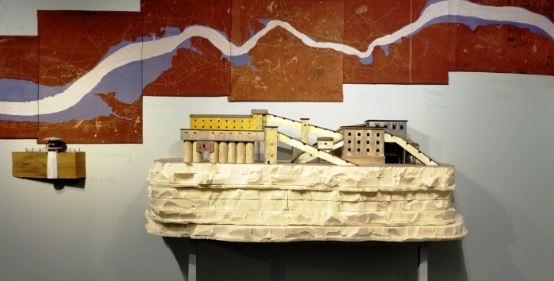
Richard Barlow Roadside Picnic II - chalk on blackboard paint on wall
The 2017 edition of the annual Exhibition by Artists of the Mohawk-Hudson Region (popularly known as the Regional) is on at the Albany Institute of History & Art and, as ever, it is a must-see for all local fans of contemporary art.

Victoria Palermo Reds - wood,
poured resin and colored plexiglas
This year's show was judged and installed by Jack Shear, a photographer, curator, collector of photography, and the president of the Ellsworth Kelly Foundation. You may recall Shear's gift last year of over 500 photographs to the Tang Teaching Museum (reviewed here); now he has given the region a different sort of gift by providing an unusual, sharp perspective on the Regional, and by adding a couple of unique elements to the show that I found most welcome.

First, Shear mined the Institute's collection for works of art that had been purchased from past Regionals over many decades; these pieces (more than 20 of them) were then installed salon-style at the entrance to the exhibition, providing a refreshing reprise of those past purchase-prize winners. I will describe Shear's other innovation a bit later.

Niki Haynes To What End mixed media collage
So - how is the show? With just 87 works by 32 artists selected from 600 submitted by 268 artists, this Regional is unusually spare - and that's a good thing. All but a few of the artists have three pieces on view (the rest have two, except for two artists with a single, very large-scale work on view: Richard Barlow, whose 27-foot wall drawing is shown at the top of this post, and Tatana Kellner, who is represented by a 12-foot grid of 30 monoprints). This added depth allows the viewer to understand each artist's point of view much better than would be possible in a broader-based, more inclusive and, presumably, more cluttered curation.

Peter Crabtree PFOA Portrait: Loreen Hackett: Activist
archival inkjet print
Further, Shear has organized the exhibition into sections that group the artists loosely under themes (nature, figure, three-dimensional abstraction) that are like curated shows within the show. This also helps the viewer probe deeper into the meanings of the individual artists' work by putting it in context; though the Regional itself is a context, these sub-themes supercede the idea of a regional identity to touch on trends that artists around here (and everywhere) are currently exploring.

Within these themes, there is an additional subset of images set into a smaller gallery (with a warning outside for those with youngsters in tow) which are all photographs of people, some of them nude. Considering that Shear's collection at the Tang includes many such images, this makes sense. One might guess that photographers intentionally submitted work of this nature, or that more people who produce this sort of work submitted to the show. In any case, Shear did the expected by including these examples, some of which are in the slightly shocking realm, but the majority of which are nowhere near that turf (such as Peter Crabtree's wonderfully sensitive portraits, an example of which is shown at right above).

Dave Waite Guardian - archival inkjet print
As a lifelong follower of photographic art, I can say with confidence that, regardless of anyone's predilections, the photos included here are worthy; they also represent a great diversity of approaches, which helps show just how much this medium has done to liven up post-modern art. Among my favorites are three traditional landscape studies by Dave Waite (example shown at center above), Ray Felix's light-infused nude portrait of a heavily tattooed young man, Allen Bryan's masterful digital concoctions, and Laura Christensen's witty, mixed-media transformations of antique pictures.

T. Klacsmann Raptor and Automata
mixed media collage
I should note that not all of the photographs are in this one room - many are also included in a larger gallery with art of other media. Among those other media, sculpture is particularly well represented, as is drawing and other works on paper. Painting has a pointedly slight presence here compared to most Regionals - perhaps a commentary on what sort of approach Shear sees as being relevant in today's art scene. The top prize in the show went to a mixed-media collage (shown at right above), and a number of other collages also are included. Again, as a lifelong follower of collage art, I'm perfectly OK with this.

Jake Fallat 1997568-1
cast aluminum
The only two oil painters in the show are about as different as could be from each other - Jane Bloodgood-Abrams makes 19th-century-style cloud studies and Paul Sattler makes neo-expressionist extravaganzas (example shown at the bottom of this post). Again, this shows the juror's integrity, as he is not following a discernible style in his selections, but exercising thoughtful and tasteful decision-making about what to include.

As for Shear's other addition to the Regional, Back: A Re-Installation of 19th Century Sculpture, is a delightfully engaging intervention into one of the Institute's staple displays, and the first time that any Regional juror has directly participated in the show as far as I know.

The 2017 Exhibition by Artists of the Mohawk-Hudson Region runs through Sept. 3, and will feature three artist talks in the galleries at 6 p.m. on one Friday each month: July 7, Aug. 4, and Sept. 1. Admission to the Albany Institute of History & Art will be free on Sunday, July 2; admission is also free every Thursday from 5 p.m. to 8 p.m.

Paul Sattler Letters to Cross (Reading the Letters from H. Matisse to H-E Cross)
oil on canvas