 |
| Joan Grubin's E Pluribus is part of Unraveling at the Opalka Gallery in Albany |
The artist Yura Adams has curated an important show at Russell Sage College's
Opalka Gallery in Albany that features three other artists and
herself. While it’s generally a faux pas for curators to include themselves in
the show they’re selecting, Adams proves to be an exception to this rule,
having plenty of experience organizing worthy exhibitions and events while being
one of the region’s best and most productive artists.
Unraveling includes Adams, Joan Grubin, Ruby Palmer, and
Christina Tenaglia, all of whom have ample room in the big space to spread
their wings, and they all do so by bringing aspects of installation into their presentations.
 |
| Yura Adams - Geologic Time, acrylic and ink on Tyvek |
Both Tenaglia
and Adams have drawn or painted directly on the walls, while Grubin created her
single, sprawling piece on-site; Palmer’s pieces aren’t site-specific, but they
claim the space physically, in one instance by straddling a corner of the
gallery. Altogether, the exhibition finds the right balance of scale and
fullness without overcrowding the venue or overshadowing any of the art, which
all works well individually and as a group.
A large
panel near the entrance to the gallery introduces the show with a concise,
cogent statement from the curator that explains the intention of the title,
including equally valued interpretations that relate to the current unraveling
(or falling apart) of society and the unraveling (or solving) of a mystery, in
this case through the artists’ steady explorations. Her summary statement
celebrating the act of “creation in the face of uncertainty” aptly describes
the show’s purpose and relevance.
Though the curator’s introduction states that these are “four
women artists,” it really doesn’t matter to me whether they are women or not. The
qualities of perseverance and resourcefulness they exemplify are generally
embodied by all significant artists (it’s pretty much part of the job description),
regardless of gender.
 |
Ruby Palmer used a minimalist dollhouse to display
ten small sculptures, five on each side |
What matters more here, as in any contemporary
art exhibition, is that the work is very good. Beyond that, one can seek to derive elements of
a show’s meaning from the personal identities of its artists (and there are
certainly many cases where that is the main point, or a significant part of it), but I don’t feel that urge in this case.
Rather, I respond to a strong collection of mostly abstract work
that emphasizes form and color more than content. There is an arguably feminine
perspective in Grubin’s wall-size construction, where the traditionally female
craft of weaving is employed, and a few household objects that reference
domesticity (including a loop potholder) are deployed, but it is so much more
than that. After all, every one of us is caught in life’s vast networks, as
helpless as the fly in a spider’s web. The title, E Pluribus, and the placement of tiny photographs of Barack Obama
and Nelson Mandela among the many parts, reveal a broader political interpretation and an inclusiveness that I think supports this point.
 |
Ruby Palmer - Surprise Ending
acrylic paint on basswood |
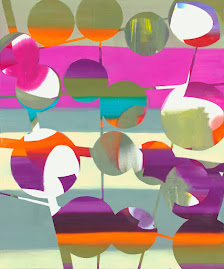
Palmer’s work also could be viewed through a feminist lens,
but her dollhouse construction (as one example) could just as well have been
made by a man, and its meaning would be little different if that were so. What
stands out for me in Palmer’s work is her sense of humor, her playfulness, and
a feeling of freedom, all of it enhanced by the power of her meticulous
application of rich colors and materials. Some of her works are clearly inspired by
stage sets, while others cross the line into domestic architecture. Either way,
they are endlessly clever, whether simple or complex.
These strengths are also in evidence in Tenaglia’s collection of
more than 30 discrete items, eight of which are wall drawings, all of them nominally
presented as one piece under the title halftones and densities. An additional installation is slyly tucked
behind a freestanding wall, all of its many elements painted the same shade of
gallery white as the wall itself. I particularly enjoy Tenaglia’s
skilled-yet-roughshod handling of her materials, which range from raw wood to
fired porcelain, and her innovative investigation of shapes.
 |
An untitled object in painted wood
by Christina Tenaglia |
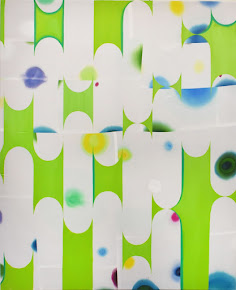
Adams is essentially a painter, but she achieves a similar
monumentality as Grubin and Tenaglia by stacking six large paintings into two
rows, nearly filling the 16-foot height of the gallery’s end wall. Entitled
Geologic Time, the six free-floating Tyvek sheets ripple
and billow slightly, their utilitarian surface reflecting light in such a way
as to seem almost transparent. These pieces are ever so vaguely figurative, and
their scale is similar to human size, building a connection between our bodies
and the environmental elements they draw from. These and several other works by Adams in the show emphasize form but also feature intriguing illusions of texture in a nod to printmaking and papermaking techniques.
Unraveling will remain on view through Saturday, Dec. 19. The gallery has generous hours (including through 8 p.m. on Thursdays) and is operating with smart COVID protocols: Masks are required, temperature is taken and travel/exposure questions answered upon entry, and a phone number is recorded for contact tracing.
 |
| Installation view of Christina Tenaglia's halftones and densities |
A note on curating: There seems to be a trend – or a
series of coincidences – in the region among certain artists, galleries, and
curators. I couldn’t help but notice that all three artists that Adams chose
for
Unraveling were also included in a recent show entitled
SpaceLAB at Troy’s
Collar Works, which was organized by Julie Torres and Ellen Letcher. That pair, in turn, made
up half of a panel of four jurors who selected the work for
Infinite
Uncertainty, the previous show at the Opalka. And Palmer was among eight
artists included in
Cut and Color, which recently closed at the Albany Airport
Gallery.




 Posts
Posts


