Get Visual is the grateful recipient of a grant from The Christos N. Apostle Charitable Trust
Showing posts with label conceptual art. Show all posts

Saturday, January 11, 2025

In memoriam: Jan Galligan

I am posting a link to Jan Galligan's online obituary for any and all who may have known him or read the items published here that he contributed to. RIP, friend. 

-DB


Monday, December 6, 2021

Short Take: Fence Select 21 at ACCR

A New Blank Tablet: January 20, 2021 12:00 PM EST, oil on cradled hardwood by Susan Hoffer, is the juror's top choice in Fence Select 21
I’ve been remiss in taking so long to get to this year’s Fence Select show at the Arts Center of the Capital Region in Troy, because it always features a wide swath of the region’s best and upcoming artists, and it ends this Saturday. But, as I am often forced to say, better late than never.

This year’s edition of the show was juried by Dan Cameron, a noted critic whose local presence seems to be increasing lately, and the 51 artists included are overall quite worthy. I regularly refer to this annual exhibition as “the other Regional,” and this year’s edition pretty much lives up to the title; seven of the included artists were also in the 2021 Mohawk-Hudson Regional, and several others have been in previous editions of that show.

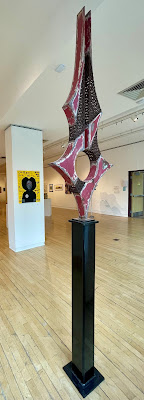
William Fillmore's Red Warning #2;
in the background is a painting
by D. Colin
photo provided
My biggest quibble with the current edition of Fence is that only a few of the selected artists have more than one work in it (specifically, six artists have two each) and those works aren’t presented together in any case. But the gallery looks good with the show as installed, and there are very few clunkers in it (I’ll leave it for you to decide which they are).

Among the outstanding pieces to my eye and mind were the following:

  • First-prize winner Susan Hoffer’s impressively self-actualizing studio view titled A New Blank Tablet: January 20, 2021 12:00 PM EST
  • ORT Project Rockwell-Nelson’s Anthropocene Epoch: Eat the Rich, a super-sharp photograph that features a live baboon in an oval-framed still life arrangement
  • Chris DeMarco’s lush, yet delicately colored photographs of a trailer park
  • Karen Gerstenberger’s two coastal monotypes
  • Jaime Courcelle’s oil on canvas It’s Not Goodbye
  • Take Out, a timely and wry nod to Edward Hopper by Marion Reynolds, and
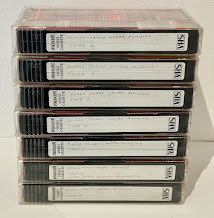
  • Michael Oatman’s elegiac stack of unwatched 9/11 videotapes (shown below)
The exhibition’s other prize-winners are Royal Brown, for a futurist reinvention of found objects; Jeff Wigman, for a Bosch-like painting on wood panel, and William Fillmore, for a strikingly geometric steel sculpture.

The ACCR is open every day but Sunday; Fence Select 21 ends Saturday, Dec. 11.

Tuesday, February 25, 2020

William Stone "Apperception" at Hudson Hall

Seated and Seatless 2006
Serendipity was my friend a week ago when I was in Hudson on a Tuesday for business unrelated to art, but ended up seeing a really cool art show anyway. Galleries aren't generally open at that time of the week in weekender-centric Hudson, but Hudson Hall was, and William Stone's solo show there proved to be worth the trip by itself.

Entitled Apperception, this collection of nearly 30 works spans the past decade (with a few earlier pieces) and provides a good range of freestanding and wall-mounted examples of this very witty sculptor's output. Working mostly in wood, Stone likes to play games with our perceptions by transforming familiar objects and materials with both dry and playful attitudes.

Some of the wall pieces use found paintings as their foundation, combining respect and irreverence in equal measure to elevate such mundane objects into something more. These include Orogeny, where a mountainscape has been jigsawed so it pops off the wall, and Signatures, a favorite piece of mine in which Stone has excised and lovingly reframed a constellation of just the signatures from half-a-dozen or so garage-sale paintings.

Live Edge Out 2018
Other wall works feature unfinished bark or slabs of lumber as the picture itself, flush-mounted or framed suitably in raw wood. These sculptures were not equally successful, but they all have the quality of making the viewer see something freshly, a worthy purpose for a piece of art. The rest of Stone's work in this exhibition (all of it freestanding) accomplishes that same goal quite neatly.

I should stop for a moment here to note that Stone is not just playing - he executes each piece with consummate craftsmanship, creating cleanly finished objects that use the qualities of fine woodcraft to mimic functionality, while simultaneously undermining it.

Fall Line 1991
So when Stone transforms three nondescript wooden chairs into one extraordinary one, by slicing them apart and reassembling them, you end up with a perfect illustration of the cliché "greater than the sum of its parts." And you can still sit on it.

Other altered chairs make up a good part of the rest of the show, along with more complex pieces of furniture apparently built from scratch. Another favorite of mine shown here is among the most recent - Stair Share, from 2019, evokes an Escher illusion, but it's neither illusory nor impossible. Rather, it is both pointless and potentially handy - a clever bit of tongue-in-cheek commentary on our fascination with finely crafted objects and their uses.

I enjoy Stone for his simplicity - or directness - and for his sly sense of humor. You will, too.

Hudson Hall (aka Hudson Opera House) is in the middle of Warren Street and is open every day. The exhibition runs through March 15.

Stair Share 2019

Saturday, June 6, 2015

Fence 50 at ACCR: Democracy in Action

Fence 50 installation view - Photos provided by the Arts Center of the Capital Region

It's been 50 years, and the Fence Show is still going strong at The Arts Center of the Capital Region in Troy. I can remember in the early '80s hanging the works on the spikes of the wrought-iron fence that gave the show its name, and it retains the wide-open feeling it had then of being a show for the people.

This year's edition attracted 382 entries from a total of 237 artists, 40 of which were submitted by 33 K-12 students, and as is the tradition, all are on display in a jam-packed salon presentation (as seen in the photo above) through June 27. Such clutter would require a stepladder - and a lot of time - to properly peruse, but that's what juror Julie Lohnes (curator of Union College's collections and Mandeville Gallery) must have done in order to choose works for the Fence Select edition of the show and designate the prizes.

A detail of Fence 50
Such a democratic enterprise has its pluses and its minuses. The only requirement for inclusion is membership in the ACCR; it appears submissions were limited to two per artist, and I'm guessing there was a size limit - but otherwise, if you brought it, it got in. The result: Everybody gets to participate (yay!) but a fair amount of truly awful work is thereby presented, and even the best work pretty much gets overwhelmed by the swirling mass of media in the show (see examples immediately above and below).

Then again, if you like to keep up with the local art scene, this affords a chance for a broad overview of it, and provides a rare opportunity to see everything that was submitted along with the juror's choices (they are denoted with a little card, visible in the photo above). This can be a fun exercise, and I guarantee every visitor will not agree with all the juror's choices of what to include or exclude.

A detail of Fence 50
My own thoughts ran naturally to second-guessing Lohnes' process, as at first I scratched my head over how few works she had tagged for Fence Select (by my count - not including the students - she picked 42 works by 32 artists out of 342 submitted by 204 artists; fewer than 13% of the entries and 16% of the artists made the cut). Man, I thought, that's harsh! But after a while, the reality began to sink in of just how much mediocre stuff was there to troll through, and I was eventually nodding in appreciation of Lohnes' careful culling.

That said, as always, some excellent work seen here will not be in Fence Select, such as a haunting black-and-white self-portrait by oft-included painter John Hampshire; two fine small photographs by Dale Winsor; and Sara Pruiksma's quirky mixed-media confections. But, overall, Lohnes got it right - choosing a good variety of media (submissions ranged from functional to conceptual in all materials) and maintaining a high level of quality. I noticed she chose a lot of graphic media (photographs and prints make up more than a third of the selected works), many rather small-scaled pieces, and not much three-dimensional work, leading me to worry that Fence Select will be too sparse.

Still, it will be intriguing to return and see how the Select edition fills the gallery and to enjoy the works in it with some breathing room. That show runs July 18 through Aug. 29, along with a solo show by last year's Fence winner Marilee Sousie. This year's prize winners are photographer Ray Felix (Best in Show) and painter Catherine Chwazik (Runner-up). The students will also be represented in a select edition of 10 works by 10 artists, including top prize winner Eliza Henneberry and runner-up Nora Kane.

Fence 50 installation view - Photos provided by the Arts Center of the Capital Region

Saturday, April 18, 2015

Jim Shaw: Entertaining Doubts at MASS MoCA

Jim Shaw - The Rinse Cycle 2012 acrylic on muslin
Have you ever tried to describe a crazy dream you had, or tried to follow someone describing such a dream? Then you will have some idea what it's like to experience the large exhibition Entertaining Doubts by California artist Jim Shaw at the Massachusetts Museum of Contemporary Art in North Adams. Shaw draws a great deal from his dreams, and attempts to manifest them physically through sculpture, painting, and installation.

Alas, it is not an entirely successful effort, just as none of us has ever really adequately articulated our own dream or understood another's, but a lot of compelling and enjoyable art is created along the way, so it's also not a failure. Shaw has great skills in drawing and painting, and a good understanding of the theatrics that go into effective installations, and MASS MoCA gives him plenty of space to spread out in.

Jim Shaw - Frank Frazetta Figure 2013 - installation view
A signature of the show is Shaw's re-use of discarded painted theatrical backdrops. The worn texture of these huge curtains of muslin, and their time-softened colors, are very appealing, and Shaw makes the most of this appeal by limiting his interventions to partial overpainting or, in some cases, simple reinterpretation by the placement of flat figures in front. Shaw also takes smaller cuts of the backdrops and paints on them like stretched canvases. These are some of the best works in the show, perhaps because it is easier to digest them, or because smaller works can concentrate the idea better. (Mind you, in this context, small is relative: say, six feet rather than forty.)

Jim Shaw - Blake/Boring 2010
ink on paper 
Another key feature of Shaw's work is his impressive mastery of comic-book style inking, which he applies to various obsessions. Clearly, he is a child of the '50s and '60s, and is completely, unabashedly in love with Superman, whose image is captured, transformed, fractured and fragmented in many ways here.

Sources as disparate as William Blake and Walt Disney are blended into the Superman myth as processed by Shaw, connecting the visionary's Songs of Innocence and Experience to the Seven Dwarves and then linking it to Kryptonite.

Jim Shaw - Fire Female 2012
faux hair wigs with airbrush
Again, I think these elements come across best when simplified, as when Shaw groups giant cutout drawings of Superman's body parts into a wall-mounted installation, or in another installation where the black-ink area of the superhero's costume shorts turns out to be a portal into a plastic dreamworld of glowing colored crystals (shown below).

Shaw also shines in book-page-scale drawings of vortices, swirls of hair, and others of his many obsessions (architecture, the human body, American Indians, snakes, and Wagner's Ring series among them).

Shaw's sculptural forays include architectural dioramas, amusing surrealistic furniture designs (such as a nose-shaped wall sconce), and bizarre wigs, which also appear in a series of paintings made over inkjet prints, rather than discarded muslin. These paintings extend Shaw's technique of altering given imagery and introduce a self-conscious reference to art history in the form of a white rectangle cut out of the colorful image, then replaced outside it as a gray-toned expressionist swirl.

Meaning what? As with the dreams, I couldn't quite get inside Shaw's head to understand the point. But I'm grateful that it's such an active place, and that an artist of Shaw's ability makes the effort to take us there. Entertaining Doubts continues through February 2016.
Jim Shaw - The Issue of My Loins 2015 (installation detail)


In addition to Jim Shaw, MASS MoCA is currently featuring several other exhibitions. Two that are particularly worthy of note:

Eclipse is a remarkable, immersive video installation by Susannah Sayler and Edward Morris in collaboration with the ecological writer Elizabeth Kolbert that commemorates the passenger pigeon on the 100th anniversary of its extinction (image at left).

Not only a powerfully moving experience of what the incredibly numerous birds were once able to do (i.e. blot out the sky), Eclipse is a brilliant example of digital technology put to an innovative purpose as art. It also offers a beautifully produced oversized publication free to visitors. Eclipse is a must-see; it continues through Sept. 1.

Bibliotecaphilia is a group show curated by Allie Foradas with support from the Sterling and Francine Clark Art Institute that brings together six very diverse artists around the theme of books.

It includes a complex interactive installation by Jonathan Gitelson that invites visitors to spend time with a great variety of books annotated by their former owners; Dan Peterman's wonderful sculpture titled The Polymer Catalog - one ton archive, which looks like massive stacks of books but is just slices of colorful recycled plastic boards; Meg Hitchcock's painstaking and beautifully transcendent collages made of individual letters cut from holy books; and a large-scale carved wooden screen by Susan Hefuna.

Also included in Bibliotecaphilia are Jean Prebe's site-specific sculpture titled The Secret Lives of Books (pictured below), and an adults-only series of nine videos by Clayton Cubitt titled Hysterical Literature, in each of which a woman sits at a table and reads aloud from a book of her choosing until she has an orgasm (you don't see what's going on below the table, but it apparently involves a skillfully wielded vibrator).

Bibliotecaphilia continues through the end of 2015.


Sunday, January 18, 2015

Mike Glier at Opalka Gallery

December 29, 2008: Stream, Hoosick, NY, 30ºF, 2008 Oil on aluminum, 24" x 30"
The title of the current show at Sage College of Albany's Opalka Gallery - meander, because you can't see much while marching - could simply express a philosophy, but I feel it also aims to serve as a sort of explanation. This 35-year survey of Mike Glier (extended till Feb. 8) features several rather disparate bodies of work - the titular meandering - each of which displays technical mastery, intellectual rigor, and engaged passion. Glier paints, brilliantly. Glier draws, with consummate ease. Glier conceptualizes, deeply and effectively.

Satisfaction: Untitled, 1989
Charcoal on paper
12.5" x 9.25"
But there remains the sticky problem of Glier's diversity, and it can't be overlooked. We want our artists clearly recognizable - the market dictates this, and people's overworked minds and hearts demand it. How then do we view an artist who refuses to present a unified vision, who is - inconstant?

I'm not very familiar with Glier's career history, but I expect this variability - or the appearance of variability - has plagued him. I also assume he has chosen not to let the perception of others affect him very much - otherwise, why run the risk of changing tracks? In this very ambitious presentation of great swaths of his best work, Glier and curators fearlessly place portraits next to abstracts, text-splashed sticks next to landscapes, and political commentaries next to familial musings.

Garden Court: Summer, 1994
Acrylic, charcoal on canvas 120" x 90"
The overall effect is impressive, but confusing. While Glier's skill and commitment are undeniable, one must read the wall text and label details to grasp the singularity of his vision, which is more about ideas than images. In the end, his message is primarily as an environmentalist, expressed by a talented painter who is as deeply sensitive to humans and other creatures as he is to the land they inhabit, who is worried about political and economic power-mongering, and who strives to make these concerns apparent in his lushly beautiful art.

Rather than try to describe it all to you, I offer a few choice examples here (leaving out the overtly political work, which I find caricaturish) and urge you to go see for yourself what Glier does so well, and has done for all these decades.

Also, at 3 p.m. on the last day of the exhibition (Sunday, Feb. 8), the gallery will host a talk by Sage professor Steven Leibo on the effects of global warming in this region. After the talk, Glier will be on hand to answer questions about his work. That should provide a great opportunity to understand this complex artist a little better.

Shade Turf with Nine Mice, 2001
Charcoal, oil on aluminum panel  60" x 60"