Get Visual is the grateful recipient of a grant from The Christos N. Apostle Charitable Trust
Showing posts with label albany. Show all posts

Saturday, January 11, 2025

In memoriam: Jan Galligan

I am posting a link to Jan Galligan's online obituary for any and all who may have known him or read the items published here that he contributed to. RIP, friend. 

-DB

Thursday, March 3, 2022

Short Take: refract at Albany Center Gallery

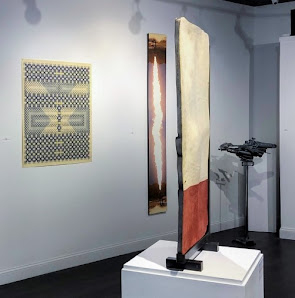
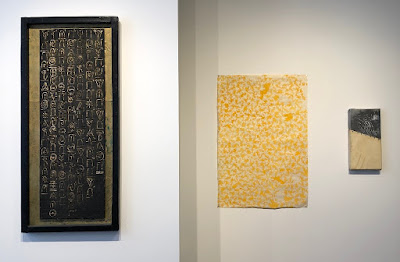
Works by, from left, Royal Brown, Naomi Lewis, and Benjamin Jose
are part of refract at Albany Center Gallery.
photos provided

The five artists in Albany Center Gallery's current show, refract, don't appear at first glance to belong together. Their media vary from video to watercolor to cast iron; their imagery from space-age to delicacy on the page. But a theme does emerge from the selection, which was organized by the gallery's associate curator, Jennie Tang. It has to do with the approach these artists take to their subjects.

Owen Barensfeld's Is It big Enough?
combines images to make a statement
This concept is best explained by the gallery's written material, which states that the five artists employ "different methods of repetitions, patterns, juxtapositions and distortions" to broaden our understanding and experience of everyday visuals. Here, those visuals have become abstracted and transformed, built of mere suggestions, or created directly out of the simplicity of a grid.

The show, like many at this venue, is spare, featuring just 29 works in all. Nine of those works are by Naomi  Lewis, whose whisper-soft graphite drawings pull you in close, and whose patterned images of bees fill their surfaces expansively, often emphasizing negative space to great effect. Equally wed to overall pattern, Trevor Wilson painstakingly builds large images out of tiny squares in grids of graphite or colored pencil, the results feeling almost equal parts human and machine.

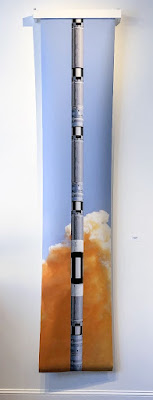
Owen Barensfeld and Royal Brown come from opposite positions to meet in a middle zone of spaceships and technology. While Brown creates colorful models of imaginary craft out of the most mundane of found objects (empty spray cans and such), Barensfeld transforms mass-media images of bomb blasts and moonshots into objects of contemplation. Both have something to say: In Brown's case, it's a literal message of love amid fantasy; Barensfeld's seems to be more about the mesmerizing terror of industrial power.

From left, works by Trevor Wilson, Owen Barensfeld,
Benjamin Jose, and Royal Brown are part of refract
Benjamin Jose seems to be the odd man out in this group. His constructions of mismatched materials struck me as being more in the realm of formalism and surrealism than anything else here, and his messages less clearly stated than the others'. That said, his highly refined use of such disparate substances as wood, steel, and leather holds its own kind of fascination.

refract will remain on view through Friday, March 4, so it's now or never if you want to catch a look. I'm glad I did.


Sunday, January 30, 2022

Go out and see a movie - Please!

Constant companion and I caught a 4 p.m. matinee of the latest Pedro Almodóvar film yesterday at Spectrum 8 Theatres in Albany - and got a private showing, as no one else was there. Admittedly, when the mercury hits single digits, it takes fortitude to leave the house, but we love movies and enjoy seeing them the old-fashioned way, so we bundled up and headed out.

Parallel Mothers is a great movie, by the way, with plot twists, first-rate acting, a deeply felt perspective on the legacy of conflict, and the wonderful, colorful Spanish settings that Almodóvar always delivers. But we left the theater feeling a bit depressed by the experience. And it didn't help to see from the street that the drinks establishment next door was chock full of patrons.

With everyone streaming at home from a hundred platforms, spooked by the Omicron variant, and just plain self-absorbed, it's hard to have much hope for the future of the small movie theaters that dependably screen the sort of movies we love: independent, foreign, plot-driven, devoid of car chases and explosions.

I've chosen to have none of the home-based means by which the majority of us now enjoy films. No cable, no Netflix, no Amazon Prime - just antenna-fed TV and DVDs from the library, augmented by online rentals from Kino Lorber, a foreign-film distributor that fills the gaps left by the Spectrum. That leaves plenty of money in the budget to pay for tickets.

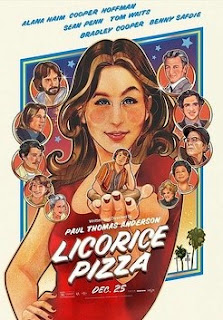
Currently, the Spectrum (an eight-screener on a main thoroughfare in the city) is showing several new releases that will contend for Oscars, including Licorice Pizza, Drive My Car, The Tragedy of Macbeth, and Nightmare Alley. I hope to see all of those before they leave the big screen, and will make an extra effort to do so. 

Going out to a movie still fills me with anticipation, freshens my step, and then fulfils that latent desire to be enveloped in the dark, alone or with friends, wrapped up in a story, with brilliant images, resonant sounds, and anonymous fellow theatergoers who sometimes have a word or two of comment during the credits.

I used to regularly run into friends at the Spectrum, and even made a new friend on occasion as we paused in the lobby to share our responses to a good film. Now, it's usually just the staff, who somehow still have jobs, but these days clearly seem to have not enough to do.

The Spectrum is part of a national chain (Landmark), which has theaters all over the United States, most of them in far larger markets than ours. I suppose those venues are making enough money to help keep this one open. But it's not something I would want to count on for long. 

So, please, if you value the presence of a great independent movie theater in your region, and wouldn't want to see it close, get up off the couch, grab a coat and the keys, and go support it. You'll be glad you did.

Note: I'm in Albany, so the Spectrum on Delaware Avenue is my go-to cinema - but there are several other small, independent movie theaters in the Capital Region that equally deserve your support, including the Criterion in Saratoga Springs and the Movieland 6 in Schenectady, both of which are owned by Bow Tie Cinemas, a national chain with 38 venues - coincidentally, the same number as Landmark.

Sunday, January 2, 2022

Catch these while you can ...

What better way to start the new year than to catch up with an art show or two that you meant to see but got too busy to get to during the holidays.

There are a few good choices in the region that will end soon, including a great opportunity to take advantage of free admission at a world-renowned museum.
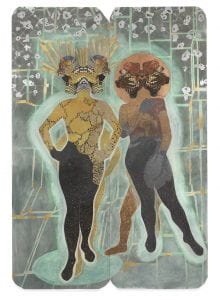
Return 2 Earth 2017, mixed media
by Alisa Sikellianos-Carter
First up, in order of ending date, would be the Annual Members Show at Saratoga Arts in Saratoga Springs, set to close on Jan. 8, closely followed by the annual Upstate Artists show at The Laffer Gallery in Schuylerville, which ends on Jan. 9. Both include a large cross-section of regional artists and are located not too far apart, providing a good opportunity to double up.

Two shows that will end on Jan. 14 also feature a great many regional artists: Gallery Mixtape, Vol. 1 at Collectiveffort in Troy, where a selection of BIPOC artists are showcased, and the Annual Members' Show at Albany Center Gallery. Well over 100 artists (myself among them) present one piece each at ACG, making for a super-eclectic viewing experience that is always popular with viewers.

An example of 20th-century Japanese
printmaking at The Clark
A solo show by one of the region's outstanding mid-career artists, Alisa Sikellianos-Carter, will re-open on Jan. 9 and run through Jan. 16 at Union College's Mandeville Gallery in Schenectady. Sikellianos-Carter, who was one of the three jurors of the 2021 Mohawk-Hudson Regional, works in large-scale mixed media with a healthy and entertaining nod toward Afrofuturism.

Perhaps most intriguing, an exhibition of 20th-century Japanese prints from the museum's collection will remain on view at The Clark Art Institute in Williamstown, Mass., through Jan. 30 - and admission to the museum will be free for the entire month. Competing Currents promises to be a highly pleasurable lesson on a unique corner of recent art history.

So, go forth and see some art! It will make a great beginning to your 2022.

Add note: This just in from the Albany Institute of History & Art - Fashionable Frocks of the 1920s, a fancy and fun romp among the clothing styles of the flapper era, has been extended through Jan. 9.

The Annual Members' Show at Albany Center Gallery is always a crowd-pleaser
photo by Daniel Joyce


Tuesday, May 11, 2021

In Memoriam: Joel Chadabe

Joel Chadabe performs in the 1970s, using a very early PC as part of his equipment
On May 2, my dear friend Joel Chadabe died at home in Albany at the age of 82. Joel was a groundbreaking electronic musician and composer who taught for many years at the University at Albany, Bennington College and, more recently, New York University.

I first met Joel in 1987, when we each were renting studio space in a renovated factory in Albany's West Hill neighborhood, and we soon embarked on a friendship that featured many facets: Technical support, creative discussions and collaborations, countless homecooked meals, and an extended series of annual New Year's Eve and Fourth of July parties at the home he shared with Françoise and Benjamin (wife and son - for more detail, see the Times Union obituary from May 9, and the New York Times obituary, which came out on May 26).

Those parties always featured a core group of the Chadabes' friends, many of them associated with UAlbany, but also often included visitors from afar. It wasn't unusual for several languages to be spoken in those evenings, and for subjects from dance choreography to theoretical physics espoused upon by actual experts. The evenings inevitably concluded with Joel at the piano and those bold enough singing songs both familiar and exotic. It was an experience of a time nearly lost to my generation, when friendship, creativity, and love of life seemed enough to conquer the world.

Throughout, Joel worked, shuttling back and forth from college to college and from Albany to New York City, where he always had some big project going on, whether a concert series, publishing venture, or recording studio. In 1997, he published an unassuming but seminal paperback book on the history of electronic music, Electric Sound, which I enjoyed immensely, despite my nearly nonexistent musical education. Joel loved sharing his knowledge and, especially, his enthusiasm for everything creative, and that attitude shone throughout the book.

In later years, Joel and I saw less of each other. He was often in New York, the old New Year's crowd was diminishing, so the parties ended, and I got busy with my own working life away from the arts. But the connection remained, and the sadness I feel from his premature departure is acute.

Joel Chadabe was truly one of a kind, a generous soul full of childlike joy, and he will be greatly missed. May he rest in peace.

Some things never change: A recent photo of Chadabe at work with a MacBook.


Saturday, April 17, 2021

The 43rd Annual Photo Regional: Youth Spotlight

Ally DeRusso - father daughter dance
Publisher’s note: Get Visual has a longstanding policy of not reviewing student work; however, the annual Photography Regional is too important to leave out. My solution for covering this year’s youth-oriented Regional was to invite a highly qualified third party to take up the challenge. I am grateful that Timothy Cahill agreed to provide the following review. –D.B.

By Timothy Cahill

The Opalka Gallery has always been slightly restless around the Photography Regional. The annual gathering of the photographic tribe has become something of a stepchild exhibition, hosted by a number of venues, each of which gives the show its own spin. In 2003, then-Opalka director Jim Richard Wilson organized the Photo Regional as an invitational, transforming what had been an open-call, juried exhibition into a curated one for the first time.

Natalia Gillespie - Abundance
For this year’s iteration of the show, on view at Russell Sage Albany’s Opalka Gallery through April 24, current director Judie Gilmore announced a new innovation: an age restriction. The 43rd Photo Regional:  Showcase on Youth would be limited to artists between the ages of 16 and 26. This ran the risk of producing an exhibition that had the qualities of an end-of-semester display: studious and well-intentioned, derivative and artistically immature. It also offered an opportunity, in the words of the Opalka’s press release, “to celebrate our region’s young photographers and offer them an opportunity to show their work alongside their peers.”

For sure, there are aspects of the exhibition that are earnest and derivative. But, as juried by Khidr Joseph, Jayana LaFountaine, and Anna Schupak, the show does not feel at all unseasoned. In its freshness, intelligence, and diversity, this year’s Photo Regional is hugely satisfying.

I’ve taught photography to undergraduates, and most were, as young people must be, possessed by themselves and their familiar surroundings. This is death to a photographer. Writers are taught to write what they know, but photographers cannot be nearly so interior. They must immerse themselves in what they don’t know - the unknowable realm of otherness that is the visible world. What they discover there becomes the foundation of their art. 

Julia Larberg - Rainbow Self with One Leg Raised
This is an issue in the age of the curated self, social media and the ego-spectacle of the selfie. But, in the hands of a good explorer, even the self can be an undiscovered country, as it is in Julia Larberg’s sunny nude, Rainbow Self with One Leg Raised, or Maggie Lang’s COVID-laden Life Under Quarantine series. I don’t know if the person in Natalia Gillespie’s black-and-white Abundance is the photographer or not, but the field of daisies used as a backdrop wraps the figure in a glorious reverie halo. Jesse Asher Alsdorf, using still life in lieu of portraiture, offers a “discovery in self worth” in his text-and-photo triptych, Bruised Flowers.    

Often, though, when these young artists turn the camera on themselves, their interest is more persona than personal. Ally DeRusso enlists the 20th-century technology of the Polaroid instant camera for her set of five diptychs, casting herself in mini psychodramas narrated by enigmatic titles: smack you in the teeth, father daughter dance, and so on. This is the case too with Madison Scisci’s black-and-white video drama, The Release, in which she films herself in a dual role that leads either to reconciliation or liberation.

Mateo Guevara Lemeland - Neon Boneyard
The woman who Sebenele Ndlangamandla depicts in Float may or may not be the artist herself, but she is clearly playing the part of the goddess. Ndlangamandla’s portrait of a woman embraced by sky and water, gazing pensively out of the frame, is placed between nearly identical images of ripples on a lake or pool, as if she rose from the water there and disappeared again. Like Botticelli’s Birth of Venus, this startling woman obviously hails from another realm.

All the photographers in this year’s Regional came of age during the dystopian regime of Donald Trump. In those years, either the past was being rewritten 1984-style by the president’s henchmen, or rendered devoid of any coherent narrative or meaning. Constant exposure to historical gaslighting might have turned these young artists ahistorical, but it hasn’t. If anything, they are the captives of history, of political divisiveness, systemic discrimination, environmental degradation. In response, documentary photography provides some of the show’s most compelling moments.

Catherine Rafferty - A Nation that Forgets
Some of the work is unsettlingly detached. Walker Bankson’s documentary portraits, like his Untitled (Miles Fighting), explore an unsettling banality in contemporary masculinity. The mordant anti-landscapes of John Bonetti (Fountain at the End of the Dam) and Anna Nuler (Ice Cream Castle) reveal the barrenness of the modern built environment. And Mateo Guevara Lemeland’s garishly surreal Relic and Neon Boneyard suggest that the world itself has somehow curdled in place.

Other documents are more visceral. Anna Schupak takes us into the middle of a protest in her Troy series. In a pair of images, Catherine Rafferty juxtaposes the overheated red-white-blue of a Trump rally with the same palette in more somber tones. Her A Nation that Forgets places the blue dress and sandal of a black woman against red paint thrown like blood on the base of a public monument, where the inscription warns, “A Nation That Forgets Its Past Has No Future.” The “white” of the image is represented visually by the paleness of the cement plinth, and conceptually in the photo’s implication of racism.

Rainer Turim - Tompkins Square Park
Inevitably, the artists engage with the natural world. In Rainer Turim’s Tompkins Square Park, a tree growing through a chain-link fence becomes a parable of humanity buckling under nature’s force. Conversely, Gennaro Vargas’ splendid Peruvian Mountains preserves a paradise of human labor in harmony with the earth.

I admit I can make no sense of the arbitrary nature of the exhibition’s 16-26 age range, except to muse, somewhat cynically, that the aim was to attract high schoolers to Sage’s art programs. As it turned out, there is no one under college age in the show, the average age being about 22. (The  only teenager is Xiaoxuan Lisa Li, whose tense, formal manipulations more than hold their own with the older exhibitors’ work.) 

Rather than the weird high-school-to-post-MFA age swing, why not a more traditional “under 30” show, a range that allows for a greater number of mature emerging artists? The three jurors, all of whom are under 26, have given a hybrid feel to the exhibition they organized. While a call for entries opened the show to all, one suspects some of the artists were hand-picked by the jurors from among their friends and colleagues. The final selection feels more curated than the typical juried exhibit. 

Xiaoxuan Lisa Li - Bat I
This hybrid quality is heightened by the inclusion of the jurors’ own work in the exhibit. This is a major departure from prior Regionals, in which the jurors functioned entirely as disinterested umpires, not player-coaches. The show is organized to mitigate the confusion this might cause, with the jurors’ work sequestered in the atrium of the Opalka Gallery, separate from the main body of the show. But it’s unclear how exactly to read this separation: is the juror’s showcase part of the Regional, or an adjunct exhibition?

These are serious questions but, ultimately, they should not detract from the Regional’s comprehensive virtues: its quality, its presentation, and above all its exhilarating diversity. In what has too often been an exhibit of aging white dudes, this year’s 37 artists and 76 artworks provide, in both surname and subject matter, a purposeful look across racial, gender, and geographic boundaries. Yet the jurors’ obvious attention to identity never overwhelms the individual artists’ voices.

Jahniah Kum - Resilience
It is especially thrilling to see the work of so many young black artists on view here: Tyler Ki-Re’s lushly extroverted Unchained; Jahniah Kum’s intimate domestic documents Marz and Resilience; the tender maternal portraits of Jayana LaFountaine’s Postpartum series.

Singularly impressive are the “portraits” of six black sitters in Khidr Joseph’s Make Afros Great Again series.

Joseph gives us the backs of their heads, emphasizing their hair styles, and it’s enough. From this, we get a smart and sensuous alt-MAGA manifesto about black people’s hair and its fraught history of political and social meaning. The centuries of this struggle cannot be separated from the work’s visual beauty. Nevertheless, at a certain point, I surrendered entirely to the artist’s retinal stimulations - the pleasure of the textures revealed by his studio lights, and their kinship to the eros of color, of hair, flesh, fabric, even the chromatic seamless backgrounds. The “anonymity” of the sitters yielded to their uniqueness. The last and highest diversity is the inviolable individual.

Timothy Cahill has reviewed art in the Capital Region since 1995. He has exhibited his photography in the Photo Regional and other group and solo exhibitions. His work is in the collection of the Albany Institute of History & Art.

Khidr Joseph - Make Afros Great Again


Sunday, March 7, 2021

Earthly at Esther Massry Gallery

An installation of numerous works by Julie Evans is the focal point of Earthly
all photos provided

The current five-person show at The College of Saint Rose's Esther Massry Gallery in Albany is a lively, cohesive example of curatorial ingenuity.

While each artist in the show is highly skilled and clearly worthy of attention on her own, in this setting the five women's works take on greater complexities of meaning through their interrelationships, losing nothing of individual strength in the bargain. The theme of the show, which is entitled Earthly doesn't shout - in fact, it's so subtle you could miss it altogether - but it succeeds in holding the collection together organically.

Odessa Straub - Supplemental Soul Suppository 2019
I don't have a favorite in this show, though I'd say the layered, lyrical installation of nine ink-on-Mylar assemblages by Julie Evans is its focal point. Dated 2011-2014, these mixed-media organic abstractions retain their freshness, enhanced by the playful nature of their presentation here, in which an unframed series of swooping and morphing forms adhered directly to the wall serves as a lattice to connect the more stolid framed and mounted works.

Also installed directly on the walls are three of four sculptures by Odessa Straub (the fourth being a freestanding floor piece). Straub has a Surrealist bent, with a Dadaist sense of humor and surprise. How else could one so elegantly combine such inapt objects as a live underwater plant and a leather speed bag (the type used by boxers to train), among other witticisms? There's also an undercurrent of mad-scientist menace to Straub's combines, while they are still sleek, playful, and colorfully pleasing.

Meg Lipke - Garden Gates II 2020
Meg Lipke also works in three dimensions, but her two pieces in the show play off the wall as pumped-up frames that become their own pictures. Lipke's more modest piece (which is untitled) has multiple openings in a pillow-like structure of stuffed fabric, with highly vivid coloration activating its upbeat claim on a small square of wall space. Her much larger Garden Gates II, also made of painted stuffed fabric, is less bright and slightly droopy - but, at nearly 9 feet tall, its presence is clearly stated.

Yet another sculptor, Tamara Zahaykevich, is represented by a group of five pedestal-mounted forms that hold together quite nicely as a group, though they span well over a decade of production from 2007 to 2021. Like Evans' work, these lean toward abstract biomorphism, with a limited color palette and carefully worked surfaces.

Two Tamara Zahaykevich sculptures
Variety comes as Zahaykevich works these pieces' surfaces in many different ways, from meticulously detailed to roughly scrubbed. One piece, entitled Robert Wisdom is more architectural, as were some of Zahaykevich's pieces that were included in the excellent Cut and Color show that recently ended at the Albany Airport Gallery.

The overall installation of earthly is somewhat sparse, which allows for one side of the gallery to remain unlit for viewing the wall-projected video contributed by Laleh Khorramian. Entitled I Without End, the nearly 7-minute-long time-lapse animation is a curious vision of sad romance, played out by carefully cut orange peels in a miniature chateau-like setting.

Khorramian's soundtrack ranges from lightly industrial to orchestral, including atmospheric voices at times, and it sits comfortably in the gallery space, not loud, almost soothing. Her imagery is at turns abstract and representational, but its real magic comes in the unpredictable movements of drying organic material over time, and it is surprisingly affecting. I don't have a lot of patience for longer-running video clips in a gallery setting, but this film held my attention for two complete viewings.

Credit is due the two curators of Earthly, Saint Rose Associate Professor of Art Susan Meyer and Massry Gallery Manager Erin Sickler, who've assembled this grouping with sharp eyes and clear minds, allowing the whole to honor each of its parts. The show will remain on view through March 17.

A still image from Laleh Khorramian's 2008 animation I Without End 

Sunday, February 28, 2021

Terry James Conrad: Object Permanence at Opalka Gallery

Terry James Conrad adjusts his musical installation at the Opalka Gallery.
all photos provided
We’ve all heard of the three Rs - Reduce, Reuse and Recycle – and most of us know that the first two are the more effective approaches to problems associated with waste. But they’re also harder to do, so we’ve tended to focus on recycling, which, also known as remanufacturing, has more and more clearly been revealed as not much of a solution at all.

Tin cans reduced to essential shapes
It’s admirable to try to reduce our production and consumption of stuff, but there’s a conundrum in it: Doing things – which often means making things – is what gives our lives meaning. And that goes double for studio artists. Just try to imagine all your favorite creators having built their careers without leaving behind a trail of stuff. Not at all likely.

All of which makes the unusual approach to making art that Terry James Conrad has pursued so fascinating. Currently the protagonist of a solo exhibition and series of events at Sage College’s Opalka Gallery in Albany, Conrad has taken that second R to heart, and made Reuse his raison d’etre. The result is both intriguing and – perhaps a surprise - esthetically appealing.

One of Conrad's presses in use - the paper
is at the bottom, under the cans
Conrad is essentially a printmaker, though this installation also includes numerous small sculptures, four handcrafted wooden guitars, and a large musical apparatus, in addition to three homemade printing presses that are being actively employed during the exhibition. The level of skill involved in all these works is extremely varied, from pounded, foil-wrapped tin cans that evoke outsider art to fancy woodworking and metalcraft on the guitars. Somewhere in between is the Rube Goldberg-esque music machine, which Conrad set into sonorous motion during my visit. (He’s in the gallery every Thursday adding a residency component to the show.) Unlike many sound installations, the contraption’s rhythmic emanations were not unpleasant or intrusive; rather, they suited the room and the other art in it quite nicely.

It’s worth trying to explain about those presses. Conrad has invented a unique method of printing, which uses gravity to create downward pressure on a matrix of folded, joined, and grouped tin cans that are placed on top of the printing paper. Each press is a multilayered stack of found stuff, not all of it functional, but all of it adding to the overall visual and symbolic effect of the conglomeration. After homemade inks are piped into the interior spaces of the cans, where they pool and soak for several days, an embossed and colored image will be permanently impressed upon the page, formed of deep lines from the cans’ edges and flowing colors within and around them.

Conrad has embellished these found cans with colored foils 
Conrad makes his inks from everyday sources like walnuts and rust, and uncommon ones, too, such as silt taken from 565 meters below the ocean. Many of the more than 30 finished prints in the exhibition are displayed without frames or glass, making it easy to examine their soft textures and subtle variations in tone. Others are shown in frames, most notably a suite of black-on-white lithographs embellished with pastel-colored frames - but the unframed works are the stars of the show.

Four Conrad prints
The prints are abstract and have equally abstract names, and they are fun, funky, even stylish, with geometric forms and an array of mostly muted colors. Their method of display appears to be yet another Conrad innovation: Angled out from the wall on painted wooden supports, and placed well below the usual eye-level of gallery art, they invite relaxed intimacy and close examination. The experience is enhanced by the opportunity to also examine the tin-can constructions that made these prints, as they are also on view in the gallery, along with a number of simpler transformations of tin cans that evoke early Modernist minimalism.

The show is billed as a survey, with prints ranging throughout the last 10 years. Most of them have white backgrounds, but a triptych entitled Benthic is brown and soft like suede, fully stained with walnut ink around its other colors and floating shapes. Benthic is also larger than the other prints, and super-fresh (dated 2021), suggesting a strong current direction.

Terry James Conrad: Object Permanence will remain on view through March 13. The Opalka Gallery is open to the public, with generous visiting hours that include Thursday evenings and Saturday afternoons. I highly recommend that you make time to see this outstanding show by a uniquely dedicated and talented artist.

Benthic 2021 - monoprints by Terry James Conrad


Tuesday, December 8, 2020

Unraveling at Opalka Gallery

Joan Grubin's E Pluribus is part of Unraveling at the Opalka Gallery in Albany
The artist Yura Adams has curated an important show at Russell Sage College's Opalka Gallery in Albany that features three other artists and herself. While it’s generally a faux pas for curators to include themselves in the show they’re selecting, Adams proves to be an exception to this rule, having plenty of experience organizing worthy exhibitions and events while being one of the region’s best and most productive artists.

Unraveling includes Adams, Joan Grubin, Ruby Palmer, and Christina Tenaglia, all of whom have ample room in the big space to spread their wings, and they all do so by bringing aspects of installation into their presentations.

Yura Adams - Geologic Time, acrylic and ink on Tyvek
Both Tenaglia and Adams have drawn or painted directly on the walls, while Grubin created her single, sprawling piece on-site; Palmer’s pieces aren’t site-specific, but they claim the space physically, in one instance by straddling a corner of the gallery. Altogether, the exhibition finds the right balance of scale and fullness without overcrowding the venue or overshadowing any of the art, which all works well individually and as a group.

A large panel near the entrance to the gallery introduces the show with a concise, cogent statement from the curator that explains the intention of the title, including equally valued interpretations that relate to the current unraveling (or falling apart) of society and the unraveling (or solving) of a mystery, in this case through the artists’ steady explorations. Her summary statement celebrating the act of “creation in the face of uncertainty” aptly describes the show’s purpose and relevance.

Though the curator’s introduction states that these are “four women artists,” it really doesn’t matter to me whether they are women or not. The qualities of perseverance and resourcefulness they exemplify are generally embodied by all significant artists (it’s pretty much part of the job description), regardless of gender.

Ruby Palmer used a minimalist dollhouse to display
ten small sculptures, five on each side
What matters more here, as in any contemporary art exhibition, is that the work is very good. Beyond that, one can seek to derive elements of a show’s meaning from the personal identities of its artists (and there are certainly many cases where that is the main point, or a significant part of it), but I don’t feel that urge in this case.

Rather, I respond to a strong collection of mostly abstract work that emphasizes form and color more than content. There is an arguably feminine perspective in Grubin’s wall-size construction, where the traditionally female craft of weaving is employed, and a few household objects that reference domesticity (including a loop potholder) are deployed, but it is so much more than that. After all, every one of us is caught in life’s vast networks, as helpless as the fly in a spider’s web. The title, E Pluribus, and the placement of tiny photographs of Barack Obama and Nelson Mandela among the many parts, reveal a broader political interpretation and an inclusiveness that I think supports this point.

Ruby Palmer - Surprise Ending
acrylic paint on basswood
Palmer’s work also could be viewed through a feminist lens, but her dollhouse construction (as one example) could just as well have been made by a man, and its meaning would be little different if that were so. What stands out for me in Palmer’s work is her sense of humor, her playfulness, and a feeling of freedom, all of it enhanced by the power of her meticulous application of rich colors and materials. Some of her works are clearly inspired by stage sets, while others cross the line into domestic architecture. Either way, they are endlessly clever, whether simple or complex.

These strengths are also in evidence in Tenaglia’s collection of more than 30 discrete items, eight of which are wall drawings, all of them nominally presented as one piece under the title halftones and densities.  An additional installation is slyly tucked behind a freestanding wall, all of its many elements painted the same shade of gallery white as the wall itself. I particularly enjoy Tenaglia’s skilled-yet-roughshod handling of her materials, which range from raw wood to fired porcelain, and her innovative investigation of shapes.

An untitled object in painted wood
by Christina Tenaglia
Adams is essentially a painter, but she achieves a similar monumentality as Grubin and Tenaglia by stacking six large paintings into two rows, nearly filling the 16-foot height of the gallery’s end wall. Entitled Geologic Time, the six free-floating Tyvek sheets ripple and billow slightly, their utilitarian surface reflecting light in such a way as to seem almost transparent. These pieces are ever so vaguely figurative, and their scale is similar to human size, building a connection between our bodies and the environmental elements they draw from. These and several other works by Adams in the show emphasize form but also feature intriguing illusions of texture in a nod to printmaking and papermaking techniques.

Unraveling will remain on view through Saturday, Dec. 19. The gallery has generous hours (including through 8 p.m. on Thursdays) and is operating with smart COVID protocols: Masks are required, temperature is taken and travel/exposure questions answered upon entry, and a phone number is recorded for contact tracing.

Installation view of Christina Tenaglia's halftones and densities
A note on curating: There seems to be a trend – or a series of coincidences – in the region among certain artists, galleries, and curators. I couldn’t help but notice that all three artists that Adams chose for Unraveling were also included in a recent show entitled SpaceLAB at Troy’s Collar Works, which was organized by Julie Torres and Ellen Letcher. That pair, in turn, made up half of a panel of four jurors who selected the work for Infinite Uncertainty, the previous show at the Opalka. And Palmer was among eight artists included in Cut and Color, which recently closed at the Albany Airport Gallery.

Saturday, July 25, 2020

Recycled and Refashioned: The Art of Ruby Silvious at AIHA

Tea Shirts - watercolor, gouache, ink on used tea bags by Ruby Silvious
It's no secret that the greater Capital Region has long been home to a rich community of visual artists. The reasons for this are many, including location, job opportunities, cost of living, and numerous colleges and universities with strong art programs being nearby.

Most of these local artists succeed at various levels, and some are well established in other markets (such as New York City), but it's rare that one breaks out in a big way - so when that happens, it's cause for celebration. I therefore commend the Albany Institute of History & Art for doing justice to our latest local hero, Ruby Silvious, with a terrifically likeable five-year survey of her work.

I was lucky to have had the chance to visit Recycled and Refashioned: The Art of Ruby Silvious before the pandemic shut it down in late March, and I'm delighted that the museum, which has just re-opened to visitors, extended the show's run through Aug. 30, because this is a show literally everyone should try to see.

Like most successful artists, Silvious is incredibly hardworking, as evidenced by the striking quantity and range of the work in this show. But her impressive output doesn't come at the expense of quality - indeed, Silvious seems to get better the more she produces. So, while the number of works on view can be a little overwhelming (multiple viewings are advised), the repetition of many examples in her major themes serves to underscore the wonder of this artist's intensive daily practice.

That daily practice itself is a unifying theme here, as is an abiding interest in clothing (hence the fashion reference in the show's title). While Silvious employs numerous techniques, including drawing in ink, painting in watercolor and gouache, printmaking, collage, sewing - and more - the re-use of materials is an overriding methodology in her work. In addition to the used tea bags that are her claim to fame, Silvious paints on eggshells, acorns, pistachio shells, paint chip samples, leaves, stones and, yes, even paper. She also refashions packaging material into origami bras and fanciful shoes, and combines hundreds of miniature monoprints into grand kimonos.

Perhaps my favorite item in the show (among more than 200) is a ziggurat-like coil of small daily illustrations, itself featuring more than 100 separate images, which was made by drawing on an old adding-machine tape. Like a journal, it neatly and humorously represents the artist's little pleasures and worries, often recording food items (it's clear Silvious likes snacks in addition to hot beverages) and sometimes augmented with wry comments, written in flowing block letters. As I circled this looping chain of charming notations, I was dizzied as much by their seeming endlessness as by the rotating motion of my path.

Another favorite element of Recycled and Refashioned is a display of 11 artist books that date from 2015 to 2019, in which almost all of Silvious's various approaches are represented, with a few added ideas that aren't in the rest of the show (such as embroidered thread drawings of female nudes). I'm a huge fan of artist books, and I love the way Silvious gives herself the freedom to use that medium any way she likes, even hiding one of them inside a used candy tin.

In the same small gallery with these books are 18 small framed tea-bag paintings on the theme of museum goers. These incorporate tiny renderings of famous works of art, as viewed by figures outlined in black ink. I couldn't tell for sure whether the little paintings were somehow copied (say by digital printing) or actually painted by the artist - but either way, they work to draw us in to join our miniature fellow museum goers.

Though Silvious has omnivorous tastes in subject matter (I noted landscapes, architecture, other art, tea - of course, fruits and vegetables, flowers, birds, and people), her biggest obsession does seem to be fashion, and her biggest pieces in the show are full scale and (it seems) wearable, including two paper dresses and four kimonos. The origami bras number around 20, and there are 40 individual shoes made of paper, each a joyful explosion of feminine energy.

Still, the heart and soul of this exhibition is embodied in the paintings on tea bags - more than 60 in frames and more than 75 unframed in vitrines that I counted back in March. Additionally, it was recently announced that a series of 14 new tea bag paintings that Silvious made while under quarantine have been added to the show (and to the permanent collection of the Institute) since then.

There is a very nicely produced video in the first gallery that shows Silvious's process of making these paintings - from steeping the tea to the final multicolored work of art - and it brings home just how home-grown her art really is. The fact that it has carried her on fellowships to Japan, France, Italy, and all over the world in three published monographs, just shows how universally appealing this simple discovery became.

If it was just about the great ideas - re-using everyday materials, modifying junk-food wrappers, combining hundreds of prints into a kimono, or trimming a leaf with scissors - Silvious's work would be interesting. What makes it lasting is the strenuous dedication to craft, and the personal investment of her inner self that Silvious has brought to the unassuming process of making art from daily existence. This show represents a significant achievement by a local artist who's earned it. Let's celebrate that.

Saturday, July 4, 2020

Galleries are re-opening! (Part II)

Vanderbilt Estate, Hyde Park, New York, part of the Fenimore Art Museum's 
Blue Gardens: Photographs by Steve Gross and Susan Daley
As New York State’s Phase 4 of reopening kicks into gear, many major museums are getting there, too.

After months of utter drought, the Fenimore Art Museum in Cooperstown has led the charge, and is open now (as of Friday, July 3), with a slate of new shows, and reduced admission rates.

Next up will be the three biggest draws in the Berkshires: MASS MoCA, the Clark Art Institute, and the Norman Rockwell Museum. They issued a joint announcement that they’d be open with reduced capacity (per Massachusetts guidelines), controlled by timed-entry reserved tickets, beginning next weekend (July 11 for MASS MoCA, July 12 for the others).

A quote from the news release, credited to the museums’ three directors, hits just the right note:
“We strongly believe in the restorative power of art and cannot wait to share our galleries and grounds with our guests.”

Amen to that!

Additionally, the Albany Institute of History & Art has announced it will reopen on July 25 (better late than never). Watch this space for an upcoming review of the outstanding solo exhibition by Ruby Silvious that I viewed at the Institute shortly before the pandemic shutdown.

Meanwhile, according to the Glens Falls Post Star, the Hyde Collection “may open” in August, and a recent Daily Gazette report notes that Skidmore College’s Tang Teaching Museum has no projected reopening date. Neither does the Williams College Museum of Art, which plans to resume operations when the college restarts in the fall, but will remain closed to the public even then.

These are among the best museums around, and will continue to be greatly missed until they find a path to reopening. Let’s hope it’s sooner rather than later.

Until then, though, we have a lot of fresh exhibitions to get out and see this summer. Make the most of it, and please support these vital regional institutions.

Sunday, June 28, 2020

Galleries are re-opening! (Part I)

Nurse Patricia (Nurse Patti)
gouache on paper
Whether by appointment only, masked and sanitized, or take a number and wait, greater Capital Region galleries are starting to re-open with fresh shows, and it feels good to be let in the door.

I recently visited Albany Center Gallery, where two solo shows have been mounted, each with a particularly poignant place in our current historic moment.

Steve Derrick, a video game developer by trade, took inspiration from the global coronavirus pandemic to create scores of gem-like portraits of front-line healthcare workers, many of whom have already received the portraits as gifts from the artist.

Nurse Ema
Stanford Health Care, San Francisco, CA
gouache on paper
Half the gallery space is devoted to a fine set of 30 of these works, all about 6 by 8 inches vertical, hung unframed on little clipboards in a continuous line where we can confront and examine them at eye level.

This works perfectly, as many of them feature the subject face-on, giving direct eye contact. Whether behind masks, goggles, and face shields, or uncovered, the individual faces depicted have a powerful presence. Not insignificant is the fact that, in this selection, only three of the workers depicted are men, and the majority are people of color. This is who we rely on to save our lives every day.

Derrick, a highly skilled painter in gouache, applies a masterful touch to his brushed-on colors, often creating beautiful passages of pure paint where the subjects' colorful clothing is involved, and in equally rich areas depicting skin. His doctors and nurses often bear glaringly apparent PPE marks, along with bloodshot, sometimes tear-filled eyes.

But it's not all anguishing, as many of the workers also display their fierce humanity in the form of deep, searching, compassionate stares that, when you step in closer, drill right through you.

Entitled Healing: Portraits of the Pandemic, Derrick's show is not to be missed, as much for its artistic skill as for its emotional honesty.

Duane Ivan Todman at work
Duane Ivan Todman, a young painter whose life was tragically cut short in May, is the subject of a memorial exhibition in the other half of the gallery that highlights his finished works along with many sketches or works in progress (please scroll down to see my previous post for a fuller story and two of Todman's exquisite images).

While the literal fact of this show's existence is nothing short of heartbreaking, I believe Todman would be proud of the result, which is entitled Shining Light. I knew Duane, and was deeply moved by the experience of viewing his work on display. I think you will be, too, whether you knew him or not. Both shows continue at the gallery at 488 Broadway in downtown Albany through July 18.

A celebration of Todman's life will take place in a small park outside the gallery from 11 a.m. to 3 p.m. on Saturday, July 11. Tickets purchased here with a $10 donation to the Duane X Arts Foundation are required in order to attend.