Get Visual is the grateful recipient of a grant from The Christos N. Apostle Charitable Trust
Showing posts with label sports. Show all posts

Thursday, November 10, 2022

Running at 64

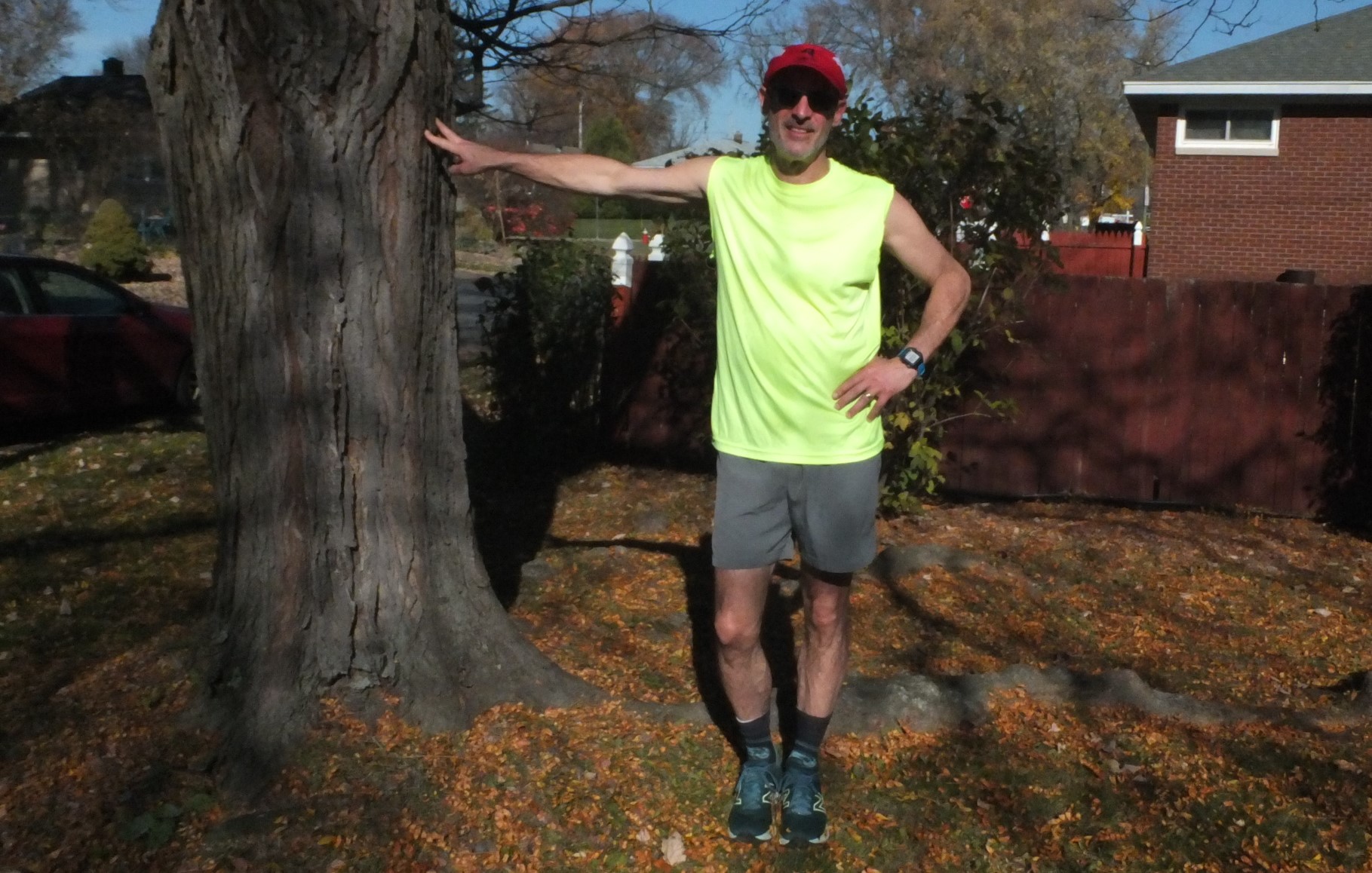
Last outdoor run of the year: Struggling a bit, but still holding up (a tree)
photo by Dick Bennett
Well, it looks like ol’ Father Time has begun to catch up with me, making this year’s running season a bit of a setback. For a couple of months I was plagued by minor injuries – or perhaps they are better called “conditions.” Left-hip sciatica that made half of my leg numb (hard to run when your leg can’t feel), a nagging pain in my right big toe (arthritis, gout, or a strained tendon?), and the occasional basketball-induced sprained ankle conspired to reduce my usual training to a mere trickle for most of the summer.

Before all that first-world agony, I had an OK start to the season, running my usual slate of 5k races in April, May, and June at a reasonably decent pace for springtime. That amounted to one race each month, with two top-three age-group finishes being the results, more or less in line with past years.

Finishing the Dunkin' Run 5k in 28:19
photo by Joe Putrock
But then the problems began, and I struggled to recover – though I’m glad to report some minor success in the end, with moderately acceptable showings in my last two races of the season. That included a surprising 2nd-place age-group finish in my home race, the Dunkin’ Run 5k, for which I received a rather ugly medal – a fitting representation of the overall season, during which I never broke 28 minutes for a 5k, a mark that was so routine just a year ago as to be unremarkable. Now, all at once, it’s unattainable.

But that’s OK. I’ve seen age suddenly overtake many of my senior-league basketball cronies, when guys in their sixties and seventies who for decades have appeared impervious to wear and tear seem to lose their sharpness and skill almost overnight. You never know when it’s going to hit, or how hard – but it absolutely will come.

This awareness of the universal fragility of our mortal body has made me that much more grateful that I still can get out for a good run on a beautiful fall day, and can still walk onto (and off of) a basketball court under my own steam. Cherish those moments!

And I truly do … with hoops season in full swing, my team is off to an impressive 6-1 start, and my injuries (for now) have subsided, leaving me able to play at my best most of the time. Though it’s not the same as a beautiful long jog in the open air, it’s still a good run, with all the attendant healthy benefits. As for racing: There's always next year!

On another note, somewhere amid the physical limitations of the summer, I managed to get up on water skis for a few minutes, which was terrific fun. It was the first time I'd tried that in at least twenty years, and will probably be my last, as I was sore for days afterward! Here’s proof of the feat, offered up for your amusement (video by William Laviano).

Hope you have a great fall and winter! See you next year. 

Tuesday, October 26, 2021

Running at 63

It isn't getting any easier! My first 10k race.
photo by Denis Nally
One thing about runners is that we are persistent. While a lot of people let the pandemic keep them indoors and out of shape, we just kept on running, even if the usual races that keep us motivated were mostly canceled (or virtualized).

This year's running season was an improvement over last year's, in that we got incredibly effective vaccines (thank you, scientists!) which allowed many of the regular road races in the Capital Region to come back live.

My personal goals stayed the same, which is to just keep at it and try to maintain the pace I had established in recent years for my usual 5k distance. But that's getting harder with age. In fact, I now think, in my 64th year, that I've already peaked. Which is OK - and that's the meaning at the heart of today's story.

Now, that doesn't mean I couldn't improve my times - barring injury, it would definitely be possible, as I believe any trainer would attest. However, it would take more and more time and effort at this age, which to me is simply not worth it. After all, the benefit - and purpose - of all this is to be healthy, not to be faster than someone else. And it's well documented that the speed you run has almost nothing at all to do with the health benefits you gain from running.

So, this year, as before, I continued to run approximately every other day, for about two to five miles each time, totaling around 10 to 12 miles per week. I participated in seven races, including a couple of virtuals, and one 10k race, the rest being 5ks. I do have one more 5k race to go, a tiny one in Alplaus, where my in-laws live - so I'll have a nice little cheering section, and one last chance to set a PR (that's runner slang for personal record) for 2021 before the cold weather sends me back to the indoor track.

Happy after a lovely virtual race on the
Shining Sea Bikeway in Falmouth, Mass.
photo by Karen Ciancetta
My best 5k time so far this year is 26:20 - not too bad, and only a bit behind last year's best time of 26:11. (Interesting fact: Statistically, a runner loses 7 seconds per year per 5k, which puts me right on course in my decline.) In the races I ran this year, I placed second in my age group twice, which is similar to my prior results after age 60, but still somewhat meaningless, as it really depends mostly on just who shows up.

Case in point: For this year's JCC Dunkin' Run (my "home" race, as the course is right by my house), I decided to try the 10k distance, even though I was the defending champion in my age group at the 5k distance from the last time they had the race in 2019. I'd run 10k a few times in training and figured I could break 58 minutes or, if having a really good day, maybe even break 57.

In the end, I gave it my all (as you can see in the finish-line snap at the top of this post) and clocked in at 57:20 - finishing last out of seven men in my age group. It's not like it was even close - four of those guys were a full 10 minutes ahead of me - which is like 25 runs in baseball - and I honestly can't begin to understand how they're physically able to do it. But, for me, it was still a PR for the distance, and a successful effort.

Also, underlining the fun that comes from joining the runners' community in these events, the person who finished directly in front of me was the women's 15k winner and directly behind me was the second-place finisher - you heard right, they ran 50% farther than I did in about the same time. Two weeks later that same pair - 30-year-old Caitie Meyer and her friendly 37-year-old rival Karen Bertasso Hughes - finished 4th and 6th in the Freihofer's Run for Women. Nice company to be with on a weekend morning!

In the end, I am most grateful simply to be able to run as a senior, and to be in good health at this perilous time in our history. I may never again break 26 minutes for a 5k run, but I hope to be able to run, however slowly, for many years to come.

Thursday, November 26, 2020

Running at 62

Ready to start a virtual race with my buddy, Dick, in August (I'm the one in yellow).
photo by Dorcey Bennett
Right about now, if today were a normal Thanksgiving, countless thousands of people all over the country would be gathering for annual Turkey Trot races. Instead, a fraction of them will happily participate in "virtual" versions of those charity events, glad to at least be out there moving their bodies.

That's as good a conclusion as any to this year's pandemic-ravaged racing season, during which recreational runners experienced a near-total loss of those eagerly anticipated competitive/friendly events that help to keep us on the road, track, or treadmill week after week.

My own season was pretty good despite all that, bookended by two LIVE races sponsored by the intrepid and hyper-organized Albany Running Exchange (ARE), with a healthy handful of virtual races sandwiched in between. Though my times were slightly behind last year's, at this age just maintaining requires more effort, so I am satisfied with having regularly broken 27 minutes for the 5K distance, including my best effort, 26:11, for a virtual race on a course in Clifton Park. I also managed 26:18 on a favorite course in Ballston Spa, where the Jailhouse Rock is regularly run, and where my running buddy, Dick, and I ran it together virtually in August (pictured above before we set out).

The dilemma now is, how to get through the winter? I've been to the YMCA a couple of times on colder days, where I ran several miles on a treadmill with an increasingly sweaty and stifling mask over my breathing holes - not fun! My hope is that the Y will begin to allow runners on its indoor track (currently, for no reason I can fathom, it is restricted to walkers). Most runners will tolerate a treadmill, but it's my understanding that it's not considered good for your gait, and I much prefer actually moving through space to trying to keep up with a machine (even if that means going in little circles above a basketball gym).

Though returning to the track doesn't take away the (obviously prudent) mask requirement, it's the way I have gotten through the last couple of winters without totally losing my conditioning, so I hope to be able to continue that trend. In the meantime, I'm grabbing whatever reasonable temperature opportunities I can to run outside. (I'm willing to exercise in cold air, but I find that below 40 degrees it hurts my lungs to breathe too deeply and, one time, I gave myself bronchitis that way, so - never again.)

Another option is to just let it go, and recover from scratch in the spring - but that prospect seems even more painful than running on a treadmill all winter, so I'm resisting it. Also, I fear the loss of the psychological boost that regular running provides, not to mention the true overall goal, which is to achieve and maintain better health (as proven in many studies, running at any pace for 10 to 20 miles a week slows the aging process).

So, with diminished goals (e.g., I think it's time to abandon hope of ever breaking 25 minutes for a 5K), I plan to go forward, grateful that I can still run when so many others cannot, and with the knowledge that one day, sooner or later, I also won't be able to do it.

In conclusion, I'd like to borrow a beautiful quote from today's Times Union Preview section, in which Kristen Garzone, of Troy, said it all to writer Tresca Weinstein: A race is the celebration of the hard work you've put in, and even though a virtual race isn't as exciting as a regular race would be, it's still something we can enjoy with our immediate family members or the other people in our pod. A lot of things have been taken away from us in this pandemic, but running is still there, and when you're running, you're untouchable.

Amen to that!

Friday, November 13, 2020

The Ivy League leads, again

It took a pandemic to make me proud to be a product of the Ivy League. I received my bachelor's degree in studio art from Brown University in 1979, but it was a bad fit, and I largely hated the place, only making it through thanks to a fully credited year at the Italian University for Foreigners and a lot of time spent at nearby RISD, where I took more courses than the allowable limit for Brown students and shared housing with some of those wacky art students.

But setting aside the proto-Gordon Geckos of my time at Brown, and the centuries of entitlement that have floated the elitists who typically graduate from Harvard, Yale, and the rest, this educational confraternity has led the nation twice in making the right call on shutting down its sports programs before the coronavirus itself had the chance to do the deed more brutally.

You may recall that the first sports league in the US to declare a full stop last March was the Ivy League.

It didn't matter that they were in the midst of their annual league basketball tournament, or that the NCAAs of March Madness fame and glory would be next - the great minds of those combined institutions (including the many top scientists on their faculties) knew it was time to mask up and hunker down. The next day the NBA followed suit, leading all the other college and pro leagues that then joined the inevitable months-long pause, one by one.

And, now, it's happened again, as the second wave of the virus is taking hold of the country, and the Ivies announced on Thursday that they are canceling all winter sports. This will have immediate local impact, as two of the mots popular teams in the Capital Region (Union College and RPI hockey) compete in the ECAC, a league that includes six of the seven Ivies (making up half of the total number of ECAC teams).

And, I predict, this is just the beginning. Like last spring, there will be more canceled sports seasons to come. Don't get me wrong - I don't celebrate the loss of healthy competition for collegians, nor the potential massive loss of revenue for the professional leagues if they also shut down again; neither do I applaud the disappointment to millions of fans who need the distraction of sports entertainment now more than ever.

And I am truly grateful for the mid-pandemic professional sports seasons that were recently completed - somehow, almost miraculously, without widespread illnesses or deaths - including baseball, soccer, hockey and, my favorite, basketball.

But it is starting to look like madness to try to continue the NFL season, or to resume the NBA, etc., if things don't turn around very soon. I've no doubt that the great minds that run these leagues are currently consulting with the great minds that know the science - many of them educated at or teaching at Ivies - and that they will come to the right conclusions that will keep athletes, coaching staffs, and fans safe.

In the meantime, stream a good movie, read a good book, eat some good takeout with carefully vetted family and friends - and take good care.

Tuesday, August 18, 2020

It's the NBA playoffs!

NOTE: On Wednesday, August 26, players for the Milwaukee Bucks sparked a widespread protest of the shootings in Kenosha, Wisc., among major league teams, resulting in the postponement of that day's NBA playoff and WNBA games, as well as several Major League Baseball games. The NHL followed suit the next day. Some NFL practice sessions also were canceled.

As of Friday, August 28, those leagues were planning to resume play, based on the players' decision that it would be more effective to continue to use the high-profile platform of their televised games to promote the cause of social justice and racial equality than to go on strike.

I stand in support of the protesters in placing the need for change above the desire for sports entertainment (see the Bucks players' statement here). The following content of this post remains as I originally wrote and published it on August 18. - DB.


LeBron James of the Los Angeles Lakers and Giannis Antetokounmpo of the Milwaukee Bucks are the two best players in the NBA, and their teams each topped their respective divisions going into this season's playoffs. Will they meet in a Finals series set in October for the first time ever?
Close readers of this blog will recall that, from time to time, I write about basketball, and I can't resist the opportunity to celebrate publicly the successful return this summer of the NBA inside its Florida bubble.

I've always liked this league for its solid leadership, respect for players, and willingness to adapt to change, and the coronavirus pandemic provided further support for that opinion. The league was the first at the pro level to announce a shutdown (following the even more impressive leadership of the Ivy League, which pulled the plug before anyone else in sports), and it has been the clear United States leader in figuring out how to come back safely.

With a severely shortened season, the NBA's eight-game-per-team "seeding" round proved to be a total blast, with terrific technical innovations, stunningly competitive games, and no COVID outbreaks. I only caught a few of those games, but they were all highly entertaining, due in part to the "virtual" fans shown live on mega-screens surrounding the courts (imagine a Zoom meeting on steroids) and in part to the virtual silence, which allowed the TV audience (not to mention players and coaches) to hear the on-court patter.

The culmination of this phase of action was a fabulous "play-in" game, the first of its kind ever in the league, in which Portland and Memphis battled to a last-minute victory by the Blazers, placing them first in line to confront the league-leading Lakers in the first round of the playoffs, which began this afternoon. Portland's late run to the final seed included three consecutive games in which its star player, Damian Lillard, averaged 51 points a game. That's right, averaged.

I should also mention the classy and effective way the league has handled the urgent issue of Black Lives Matter within the context of presenting entertainment in the form of professional basketball, by establishing a long list of slogan options for players to wear (or not wear) in place of their names on the backs of their uniforms. For the first week or so of games, these slogans appeared above the number with no player name shown at all, underlining the players' desire to place this issue above their own egos. Later, the players' names were added below the numbers, while the slogans remained in the top position (I don't know if this was planned or an afterthought - I will say that it helped me identify who was who on the court, so it may have come from popular demand).

I liked a lot of the slogans, and it was interesting to think about the choices each player made - for example, a younger, brasher guy might wear "I Am A Man," while a lot of the older guys opted for "Peace" or "Education Reform." "Black Lives Matter" and "Equality" seemed to be the most popular choices - with "Equality" appearing in several different languages on foreign players' jerseys (I observed and then confirmed Serbian, Latvian, Slovenian, German, and Italian among them).

Most interesting of all was "Group Economics," touted for the approved list and then worn by Grizzlies forward Anthony Tolliver, along with a couple of other players (and quite adequately explained here). This level of educational opportunity just doesn't normally come with major league sports, and I loved seeing it as part of every game.

Meanwhile, throughout the league, there are so many stars vying for a Finals ring that fans can rightly expect plenty of fierce competition and outstanding play in the weeks to come - with no risky travel, clear and strong controls in place, and what appears to be little likelihood of COVID-related issues (unlike, ahem, MLB).

My hat's off to the NBA, its administrators, coaches, and players for having the ability to pull this off together. And may the best team win.

Wednesday, October 16, 2019

Running at 61

That's me finishing strong at the Nick's Run to be Healed 5k in Clifton Park
photos by William Laviano
About a year ago I published a post entitled Running at 60, in which I described some of the challenges of recreational running as an older person, and within which I set a new challenge for myself: To get a first place age-group finish in the annual Dunkin' Run (a favorite, as it is right in my neighborhood). I also promised to provide an update here on that quest.

Well, forgive my bragging, but Mission Accomplished. However, quite unexpectedly, this proved to be unexpectedly unsatisfying. The reason being, I'd been trying (and failing) for about two years to break 26 minutes in a 5k race - and this year's Dunkin' Run was no exception, as I clocked a 26:15. Also, the next nearest competitor in my age group was minutes behind me - so finishing first really had no meaning.

The happy 2nd- and 3rd-place finishers
After that, I felt even more motivated to try to break that pesky 26 minutes, and I trained a little harder than usual for my next race, enjoying some beautiful late summer trail runs with a friend who used to be much faster than me but - well, he's older now, so we can run together these days.

The results are proof that working harder can help you achieve success. On Sept. 27, on a perfect afternoon in Clifton Park, I ran my best 5k race yet, finishing in an official time of 25:52, good enough for second place in the 60-and-over division, while my running partner took third. Though the organizers were only giving awards to the first-place finishers at that race, I went away feeling like I'd taken home a trophy (but without the need to store it). Now THAT was my true Mission Accomplished!

So, what's next? Considering that the person who came in first in that Clifton Park race was minutes ahead of me (and my same age), maybe I can try to get better at this. Anybody think I can break 25 minutes?

UPDATE: A couple of weeks after posting this piece, I entered a 5k race in North Greenbush, sponsored by RPI. I'm not sure how, but I finished in 25:04 (to my astonishment). Clearly, the goal for next year is to break 25. Winter training, here I come!

Saturday, September 29, 2018

Running at 60

That's me, with the sunglasses, finishing the 2017 Jailhouse Rock 5K in 26:18
Few of you would know this, but I am a runner. Not one of those obsessive marathon or triathlon athletes, but a dedicated runner nonetheless.

I’ve always done sports and exercise, including soccer, cycle touring, 20 years in karate training (yes, I have a black belt), and 10 years of Senior League basketball. But running – to my surprise – has become my #1 choice to stay active and feel healthy.

Scientists agree – research has concluded that running at a moderate pace for 10-20 miles a week gives the maximum possible boost to longevity of any human activity (intriguingly, running more than 20 miles a week nets no further gains). No one knows exactly why this works, but the evidence is that it reverses the shortening of the telomeres on our chromosomes – a hallmark of the aging process – thereby increasing lifespan.

Having turned 60 a few months ago, this interests me now more than ever. I mean, I want to live long enough to do all the stuff I never seem to have enough time for. But that’s not why I started running. Actually, I always hated running. Even as an excellent school soccer player I was lazy. My high school friends who ran track and cross country never even tried to sell me on it – they knew I was hopeless – and, I admit, I still wonder how any kid could find distance running enjoyable.

But around 15 years ago I found myself too busy to do sports that take significant time so, with a YMCA close by, I began doing some treadmill running as a quick way to get that crucial stress-reducing exercise. But treadmills are dreadfully boring. So I began to run outdoors in good weather, following the advice of more experienced guys at the gym on where to go and how to do it correctly. I also decided to set a goal (otherwise, it’s tough to get motivated): To run a 5K race in a time I wouldn’t be ashamed of, which I accomplished after a few months of practice.

I didn’t keep notes, so I’m not sure what pace I was doing back then, but it was pretty much average for my age, and I was satisfied with that. I continued to run casually and race occasionally at moderate distances for a number of years, enjoying the obvious health benefits and sense of accomplishment that regular exercise will bring.

Only recently (say, in the last three years) have I begun to treat running as a sport, participating in more races, training in a more strategic way, and feeling a little more competitive about it. I even have a Garmin wristwatch now – it can track speed and distance, provide pacing alerts, and set up run/jog intervals, tools that have enabled me to improve as I apply some of the advice that more experienced runners have been nice enough to pass on.

Which reminds me – the second best thing about being a runner, after the health benefits, is the community. In contrast to my experiences with basketball, I have never had an argument with anybody involving running. Unless you’re in a race’s top three finishers overall, you’re really not racing against the other runners – you’re racing against time and the inevitable deterioration of your own body. So runners are always very supportive. I even had a guy once turn to congratulate me when I pushed past him at the finish of a trail race (I was trying to beat 30 minutes, not him). His positive response to being outpaced exemplifies the friendly atmosphere of the many races I’ve participated in over the years.

More about competing: When I was still in my late 50s (oh, so long ago!), I was at a distinct disadvantage in road races. Because race results are structured in age groups, usually in 10-year chunks, that forced me to compete against men five or more years younger. And, because age plays a huge role in sports ability, despite my natural talent and fairly serious effort, I’d usually finish in the middle of the 50-59 pack. I accepted that, never expected to win or place, and never did. Instead of trying to beat other similarly aged runners (some of whom are so much faster than me that it still boggles my mind), I’d be striving to match some previous effort of my own, or maybe even set a new personal best.

A medal for a geezer
But, as old Father Time has marched on, it’s gotten harder to keep up even with myself. And, right on cue, this 60th birthday year things are even tougher. Try as I might to improve – or at least maintain – I am simply weaker and slower than last year. Not that the running doesn’t still go well or feel good – it does! – but the same effort produces noticeably diminished results.

Then again, those 53-year-old kids that crushed me in last year’s races are no longer in my division – suddenly, I’m the baby in the group. And I’m still running pretty well compared to the past, making me far more able to compete with the over-60 set.

This new reality didn’t sink in until last week, when I entered the Dunkin Run, a 5K race that I run every year, always producing average results. My goal for this year’s race was to break 27 minutes (a feat I accomplished regularly in 5K runs last year but hadn’t done yet in 2018) and, with maximum effort, I reached it, finishing in 26:51. Mission accomplished, on to the next goal.

But then – to my complete surprise – the race results were posted and I learned I’d finished second in the division! I even received a medal.

So, now, I’ve got a new problem. The guy that beat me in this year’s Dunkin Run (a pretty speedy 65-year-old) did it by only 13 seconds. If I had been just a little better prepared, maybe kept to a more consistent pace – I could have taken him! As for those phenomenal guys in the 50-59 division? They were still minutes ahead of us – but none of them is anywhere near 60 yet. In other words, next year a first place finish is within my grasp!

So, it looks like I have a new goal. I’ll be sure to let you know how it turns out. But, for now - gotta run!

Sunday, March 20, 2016

Bring on the Madness!

Players for the #15 seed Middle Tennessee State basketball team celebrate
their first-round upset of #2 seed Michigan State in the NCAA tournament.
photo from USA Today
Those who know me know I am crazy about basketball.

Not so much as a fan: First, I'd rather play than watch; second, I don't follow any particular team; and, unlike about half of the American population, I have never filled out a bracket.

But then there is March Madness. Even the most casual observers can't avoid the annual fever that overtakes the country, as NCAA basketball goes all out for its national tournament, and everybody is talking about Cinderellas, dynasties, and bracket-busters.

Recent years have seen the Madness get better and better, as lesser-known programs build success on the regional level and then shock the college hoops world with surprising runs to the second and third rounds of the tournament (or beyond). Despite the politics behind selection and seeding, and the inherent unfairness of the bracket system that always pits the highest-ranked teams against the lowest-ranked ones, parity and upsets are becoming wonderfully common.

Sports at this level are always fun to watch, whatever the game, because you see top talent giving it their very best for high stakes. The built-in drama of the madness of March adds emotion and excitement to the experience, and generates great stories. For me, whether it's hockey, soccer, golf, tennis, or baseball - men or women - playoff sports are always worth watching (even football, which never quite holds my attention otherwise).

But hoops is the best. And here's why:
  1. Constant action (also offered by hockey and soccer)
  2. A lot of scoring (the lack of which is the chief drawback of the other two sports named in #1)
  3. Whole team involved in almost every play
  4. All players must contribute on both offense and defense
  5. Time pressure
  6. Skills, skills, skills (you can specialize in basketball, say as a three-point shooter, but nowhere near as much as in baseball and football)
  7. Sheer athletic ability (ever seen a hoopster with a huge gut?)
As I am a reluctant TV viewer (who, by personal decision, watched none at all from 1971 through 1984, and have never subscribed to cable), it takes a lot to make me sit on the couch for more than a half-hour - something like Breaking Bad, or Downton Abbey - but I'll sit there today for hours, just as I did yesterday and the day before, and the night before that getting way too little sleep for a proper Friday at work, and I'll do it again next weekend, and so on. Until the Madness ends.

Because it's that good.