Get Visual is the grateful recipient of a grant from The Christos N. Apostle Charitable Trust
Showing posts with label furniture. Show all posts

Tuesday, February 25, 2020

William Stone "Apperception" at Hudson Hall

Seated and Seatless 2006
Serendipity was my friend a week ago when I was in Hudson on a Tuesday for business unrelated to art, but ended up seeing a really cool art show anyway. Galleries aren't generally open at that time of the week in weekender-centric Hudson, but Hudson Hall was, and William Stone's solo show there proved to be worth the trip by itself.

Entitled Apperception, this collection of nearly 30 works spans the past decade (with a few earlier pieces) and provides a good range of freestanding and wall-mounted examples of this very witty sculptor's output. Working mostly in wood, Stone likes to play games with our perceptions by transforming familiar objects and materials with both dry and playful attitudes.

Some of the wall pieces use found paintings as their foundation, combining respect and irreverence in equal measure to elevate such mundane objects into something more. These include Orogeny, where a mountainscape has been jigsawed so it pops off the wall, and Signatures, a favorite piece of mine in which Stone has excised and lovingly reframed a constellation of just the signatures from half-a-dozen or so garage-sale paintings.

Live Edge Out 2018
Other wall works feature unfinished bark or slabs of lumber as the picture itself, flush-mounted or framed suitably in raw wood. These sculptures were not equally successful, but they all have the quality of making the viewer see something freshly, a worthy purpose for a piece of art. The rest of Stone's work in this exhibition (all of it freestanding) accomplishes that same goal quite neatly.

I should stop for a moment here to note that Stone is not just playing - he executes each piece with consummate craftsmanship, creating cleanly finished objects that use the qualities of fine woodcraft to mimic functionality, while simultaneously undermining it.

Fall Line 1991
So when Stone transforms three nondescript wooden chairs into one extraordinary one, by slicing them apart and reassembling them, you end up with a perfect illustration of the cliché "greater than the sum of its parts." And you can still sit on it.

Other altered chairs make up a good part of the rest of the show, along with more complex pieces of furniture apparently built from scratch. Another favorite of mine shown here is among the most recent - Stair Share, from 2019, evokes an Escher illusion, but it's neither illusory nor impossible. Rather, it is both pointless and potentially handy - a clever bit of tongue-in-cheek commentary on our fascination with finely crafted objects and their uses.

I enjoy Stone for his simplicity - or directness - and for his sly sense of humor. You will, too.

Hudson Hall (aka Hudson Opera House) is in the middle of Warren Street and is open every day. The exhibition runs through March 15.

Stair Share 2019

Saturday, December 24, 2016

The Art of Seating at AIHA

Synergistic Synthesis XVII sub b1 chair 2003, Kenneth Smythe
Amid the hustle and bustle of the holidays, there's an end-of-year chance to catch a marvelous traveling show at the Albany Institute of History & Art before it moves on after December 31.

Fancy side chair, c. 1820, unknown designer
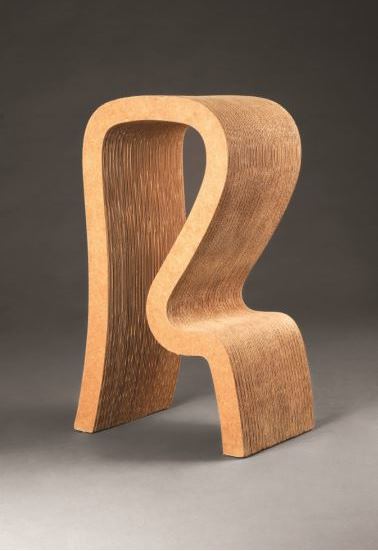
The Art of Seating: 200 Years of American Design was organized by the Museum of Contemporary Art Jacksonville, and is a delight for anyone who has ever sat in a chair or wondered what it would be like to try to improve on that experience. Featuring 43 individual specimens in pristine condition, this collection runs the gamut from simply stated wooden rockers to gaudy stuffed confections to space-age sittable sculptures.

High Stool 1971, Frank Gehry
Though one can easily consider these as works of art, most were production models and widely marketed when they were made. For me, this adds to the joy and intrigue of looking at the creations on view: The designers didn't just solve the problem of imagining a new and visually arresting way to support your rump - they also managed to find a way to sell it.

Of course there are economic failures peppered through the show - this sort of background information is nicely summed up in printed labels set up on stands by each chair - but there are no functional failures presented: Every chair in this selection is stunning, and they all appear pretty nice to sit on, too, though naturally that is severely prohibited here (though, if you're like me, you will struggle to resist the urge to try).

House of Representatives Chamber
Arm Chair 1857, Thomas Ustick Walter
I'll admit bias - I am a fan of design (particularly modern design), so I ate this collection up like a fresh Christmas stollen ... but, objectively speaking, the items shown in The Art of Seating are all first-class pieces in gorgeous original condition or expertly restored, and they are simply beautiful.

And, there are other good reasons to visit the museum now - Joan Steiner's Look-Alikes - vivid and impossibly clever dioramas that are the basis for her successful picture books - are on view through Jan 29; and Rock & Roll Icons: Photographs by Patrick Harbron will be there through Feb. 12. The Look-Alikes are scattered throughout the museum, making a perfect treasure-hunting activity for kids of all ages; and Harbron's show includes a lot of nostalgic artifacts such as guitars and concert posters, along with his excellent photos of the stars, which will please a certain age-range of former kids.

Note: The AIHA is closed on Christmas Day and on the observed holiday (Monday), but will be open from Tuesday through Saturday, Dec. 27 to Dec. 31, from 10 to 5 each day and from 10 to 8 (with free admission after 5) on Thursday.

Large Diamond Lounge Chair, c. 1952, Harry Bertoia


Wednesday, August 24, 2016

Masterworks at AIHA

This 1817 map of the proposed Erie Canal is part of Masterworks: Paper
With trips to all the summer shows winding down, I'd like to recommend a really worthy exhibition closer to home. Actually, this is a pair of exhibitions with the unifying theme of a deep exploration of the collections of the now-225-year-old Albany Institute of History & Art, entitled Masterworks: 225 Years of Collecting and Masterworks: Paper.

Thomas Cole - Button Wood Tree, ink over pencil 1823
These shows were mounted during the past year to celebrate the Institute's anniversary and its own history, with the larger, more inclusive exhibition featuring a thoughtfully constructed timeline of the organization, punctuated with compelling artifacts and objects such as grandfather clocks, a book of wool samples, paintings from three centuries, marvels in glass and silver, a fire bucket, travel posters, etc.

The richness of the AIHA's holdings is well displayed here, and would be difficult to exaggerate. Though I am biased toward contemporary art, I can enjoy a sumptuously festooned French-style bed as much as the next guy, along with almost absurdly decorative cast-iron stoves, Americana in the form of elaborately incised powder horns, ceramics from near and far, and plenty of earlier fine art.

Tea Caddy with paper filigree 1804
The Paper show has had a shorter duration, due to the fragility of its contents, but the restriction to one material still allows for so much diversity that its designers created no fewer than 16 distinct sections for it, with titles such as Landscape on Paper, Weather on Paper, Certified on Paper, and so on. Though this organizing principle has merit, I have to say it didn't really work - in fact, the Paper show is so crowded that navigating through it is a confusing chore - but it is so stuffed with marvels that it's worth every effort.

Among my favorites (shown at left) is an architectural rendering of Albany's "first skyscraper," an elegant bank building on State Street that still stands (though in rough shape), where it is now overshadowed by the much taller, nearly new building next door that I happen to work in. There is also a great range of first-rate works of art in the show, including nearly every paper-based medium - even painstaking cut constructions, along with every sort of print, watercolors, photographs, and drawings by some major names: Charles Burchfield, Jacob Lawrence, Ellsworth Kelly, and contemporary artists Harold Lohner and Phyllis Galembo.

Alice Morgan Wright
The Fist, painted plaster 1921
Meanwhile, back at the 225 Years of Collecting show, there are many, many more great artists, most significantly the heart and soul of this collection - its Hudson River School paintings - but also a spate of other excellent works representing social realism, Cubism, Surrealism, Pop, even post-Modern work.

If you're going, you need to hurry, as Masterworks: 225 Years of Collecting ends on Sept 4. For Masterworks: Paper. there's a bit of breathing room - it continues through Oct. 16. And there's a bargain to be  had: Through the end of 2016, Saturday admission to the AIHA is just $2.25. Go and discover - or remind yourself of - the treasure in our midst.

Tuesday, December 7, 2010

Not Just Another Pretty Place: The Landscape of New York at NYSM

The Cut oil on canvas by Cecil Chichester

Most of us wouldn't immediately think of the New York State Museum as a place with a major art collection - after all, its mission targets education, and its most prominent permanent exhibits focus on topics such as history, anthropology, ornithology, and geology. Well, it's time to reconsider that notion, as the wonderful survey exhibition Not Just Another Pretty Place: The Landscape of New York features more than 100 works of art, many of them first-rate, and all of them taken from the museum's collection.

The exhibition, which opened in early September, fills the facility's large West Gallery and is organized under four themes: Recording, Romanticizing, Utilizing, and Imagining the landscape of New York. Within each of these major themes are a number of sub-themes, all of which are clearly and concisely explained on monochromatic wall panels. The overall design of the show and text panels is very well executed and user-friendly, with the exception that it is at times difficult to figure out which theme a sub-theme belongs to.

At the entry to the exhibit is the "Recording" section, which emphasizes the physical features of the New York landscape, and includes one of my favorite pieces in the show, a multicolored "textural" rendering of the state by the Geological Information Survey's computers. Other examples from this section are "Bird's Eye Views" that detail the layout of towns such as Jamestown, as rendered by a 19th-century lithographer; images of the industrial landscape as shaped by the abundant presence of lakes and rivers in New York; quaint house portraits ("The Domesticated Landscape"); and a sub-section titled "Capturing New York on Film" that includes a nifty group of 12 color lantern slides laid out on a backlit pedestal, and a jarring video presentation of some of the countless frames taken by the state every few years to document all 16,000 miles of New York's roads at the rate of 100 shots per mile.

The "Recording" section also includes the largest piece in the show, a painting about 20 feet long that depicts in an ever-so-slightly naive style the arrival of scores of tall ships in New York Harbor during the nation's bicentennial celebration in 1976. The most prominent vertical feature in this frieze-like tableau are the twin towers of the World Trade Center - a sobering reminder of our more recent history, and of the thought that 1976's cheery optimism can probably never be recaptured.

Next comes the "Romanticizing" section, where artistic expression takes on a central role. Here, the Hudson River School is prominently represented by a special zone dedicated to the Albany painter Asa W. Twitchell, and several other examples, the best of which is a dramatic and vividly detailed watercolor by Jasper Cropsey (reproduced at the bottom of this post).

Tourism is examined in the "Utilizing" section, which includes a wonderful two-sheet lithograph of Blondin Crossing Niagara Falls for Lloyd's News, as well as a sub-section on cityscapes that features many enjoyable surprises, such as pastoral views of the Flatbush and Bushwick sections of Brooklyn before they were citified, a village-like State Street, Albany, 1805, and two really nice examples of printmaking: Fairfield Porter's 1960 lithograph titled Sixth Avenue II, and a richly colored, geometric 1980 aquatint with a glowing, white Citicorp building by Kathleen E. Gallagher.

A related group of pictures from the sub-section "New York as Seen by WPA Artists" hangs nearby. The six included are outstanding examples selected from a large and ever-growing collection of such work that the NYSM began acquiring in 1943 (one is reproduced at the top of this post).

Also in the "Utilizing" section is a sub-section called "Embellishing the Landscape," which describes the 19th-century interest in elaborate gardens and shows fine examples of the type of wrought-iron fencing, bench, and decorative vase that such gardens might incorporate; a "rustic" bench, made of natural wood and perhaps meant to be placed along a woodsy path, is also included. These and other objects in other sections enliven the exhibition with their concrete three-dimensional presence.

The final section of the show, "Imagining," stretches from decorated plates and furniture to a posthumous portrait of the painter and inventor Samuel F. B. Morse (shown above at right), and also includes a dreamy Thomas McKnight silkscreen of a moonlit New York City under a blanket of snow. The show concludes with a sub-section titled "The Landscape of Memory," which introduces the art of Frank Eckmair, whose woodcuts are the focus of another current NYSM exhibition of the same name. I will review that show (which runs through next fall in the Crossroads Gallery) in a future post.

Not Just Another Pretty Place: The Landscape of New York continues through March 3, 2011.

Rating: Must See
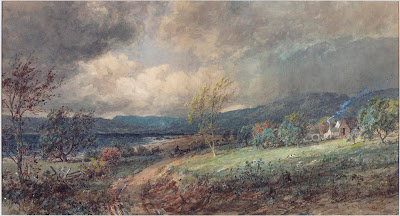
Storm Across the Hudson watercolor 1883 by Jasper Francis Cropsey