Get Visual is the grateful recipient of a grant from The Christos N. Apostle Charitable Trust

Thursday, March 3, 2022

Short Take: refract at Albany Center Gallery

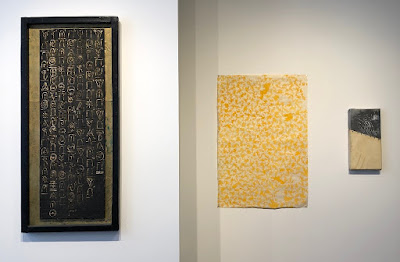
Works by, from left, Royal Brown, Naomi Lewis, and Benjamin Jose
are part of refract at Albany Center Gallery.
photos provided

The five artists in Albany Center Gallery's current show, refract, don't appear at first glance to belong together. Their media vary from video to watercolor to cast iron; their imagery from space-age to delicacy on the page. But a theme does emerge from the selection, which was organized by the gallery's associate curator, Jennie Tang. It has to do with the approach these artists take to their subjects.

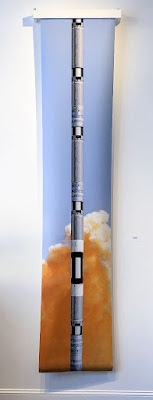
Owen Barensfeld's Is It big Enough?
combines images to make a statement
This concept is best explained by the gallery's written material, which states that the five artists employ "different methods of repetitions, patterns, juxtapositions and distortions" to broaden our understanding and experience of everyday visuals. Here, those visuals have become abstracted and transformed, built of mere suggestions, or created directly out of the simplicity of a grid.

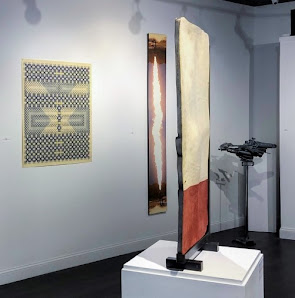
The show, like many at this venue, is spare, featuring just 29 works in all. Nine of those works are by Naomi  Lewis, whose whisper-soft graphite drawings pull you in close, and whose patterned images of bees fill their surfaces expansively, often emphasizing negative space to great effect. Equally wed to overall pattern, Trevor Wilson painstakingly builds large images out of tiny squares in grids of graphite or colored pencil, the results feeling almost equal parts human and machine.

Owen Barensfeld and Royal Brown come from opposite positions to meet in a middle zone of spaceships and technology. While Brown creates colorful models of imaginary craft out of the most mundane of found objects (empty spray cans and such), Barensfeld transforms mass-media images of bomb blasts and moonshots into objects of contemplation. Both have something to say: In Brown's case, it's a literal message of love amid fantasy; Barensfeld's seems to be more about the mesmerizing terror of industrial power.

From left, works by Trevor Wilson, Owen Barensfeld,
Benjamin Jose, and Royal Brown are part of refract
Benjamin Jose seems to be the odd man out in this group. His constructions of mismatched materials struck me as being more in the realm of formalism and surrealism than anything else here, and his messages less clearly stated than the others'. That said, his highly refined use of such disparate substances as wood, steel, and leather holds its own kind of fascination.

refract will remain on view through Friday, March 4, so it's now or never if you want to catch a look. I'm glad I did.


Tuesday, February 15, 2022

Gina Occhiogrosso: Surfacing at the ACCR

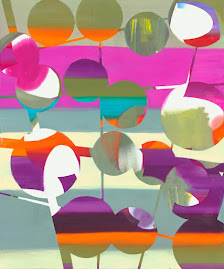
The New Natural, oil and acrylic ink on pieced and sewn muslin, 2021
During a recent talk at her exhibition in the main gallery of The Arts Center of the Capital Region in Troy, the painter Gina Occhiogrosso discussed the dichotomy of pessimism and optimism. “Most of my friends would say I’m pretty negative,” she said, while surrounded by a room full of her buoyantly colorful abstract works, effectively silencing that notion.

We are living in a time when it seems impossible to be hopeful – yet that is in a sense our only hope. Occhiogrosso understands this, and while her artistic practice remains primarily a rigorous pursuit of the purely visual, with regular forays into the topical (examples include feminism, global warming, and the pandemic), the results are clearly meant to uplift.

Migration, acrylic paint and ink
on sewn cotton, 2017
This exhibition, entitled Surfacing, is her first solo in the region in about 15 years, and it represents a sort of homecoming – for five years in the early 2000s, Occhiogrosso was the director of this gallery, and she spoke of having dreamed of one day showing there herself. Dream fulfilled, the nearly three-dozen works in this display are a comfortable fit, with a few very large colorful installations on the biggest walls in the back, a couple of much more intimate pieces set up on pedestals in the middle of the space, and paintings ranging from modest to grand in scale arrayed on the walls and columns.

Not a retrospective, Surfacing is comprised mainly of recent works, and seems to want to be about re-emerging from the isolation of the pandemic. If so, then it reveals a rather glorious private world of shimmering shapes and radiant colors – hardly the doom and gloom one might expect from an artist stuck inside for a couple of years.

Cascade, oil and acrylic
on pieced and sewn polyester, 2019 
A few earlier works show how Occhiogrosso moved into her current style, and a few works - such as the two pedestal-mounted accordion sketchbooks - range well outside of that style, providing enough context for the artist's thoughts and process to allow us to more fully understand and appreciate her primary body of work. Those pieces are consistently created by making a painting on white fabric, then slicing it into geometric pieces, rearranging and sewing those pieces back together into a square or rectangular working surface, and then painting over it again to create the final image.

In this way, Occhiogrosso allows randomness and intuition into the mix, forming a means of abstraction that doesn't depend entirely on self-expression. It's a process that works perfectly for an artist who, on one hand, entertains doubts (don't we all?) and, on the other hand, has clear ideas about what she wants to make, and a fierce commitment to working toward those goals.

Inside Out, oil and acrylic
on pieced and sewn muslin, 2020
In a review I wrote last year about an exhibition at The Hyde Collection, I commented that I was very pleasantly surprised to see how many top-flight contemporary artists are still working in the abstract mode (you can see it here). This show by Occhiogrosso is a perfect example of that phenomenon, and I am no less delighted by it here. Her command of shape and color is second to none, and she revivifies the form by means of her process of cutting and sewing back together, which evokes the early Modernism of the Dadaists (who loved a good collage as much as anything) as well as today's feminist embrace of traditional women's work.

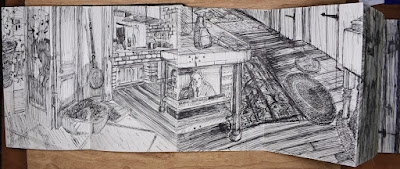
Additionally, Occhiogrosso addresses universal and personal concerns in her two accordion books, one of which elegantly depicts a flooded urban world with parallel colored-pencil lines, while the other represents the details of a domestic interior in sketchy black ink (both very skillfully drawn, I might add).

Altogether, the show is a must-see for fans of local art - Occhiogrosso is a native of Niskayuna, currently living in Troy - and just a real treat for anyone who may feel a bit deprived of color and joy in the midst of winter, or in the grip of a (let's hope) post-pandemic haze. 

Surfacing will remain on view at the ACCR through March 11; the gallery is open every day but Sunday, including Tuesday through Thursday evenings till 7.

Morgan Avenue, pen on accordion sketchbook, 2020


Monday, February 7, 2022

Drive My Car (at Nippertown)

Hidetoshi Nishijima and Toko Miura star in Ryusuke Hamaguchi's Drive My Car.
Editor's note: In a reprise of their first collaboration in 2020, in which Jan Galligan and David Brickman discussed the film 1917 in a post at Nippertown.com, they now take a look at the highly regarded Japanese film Drive My Car, beginning with Brickman's ruminations:

One thing I like about Japanese director Ryusuke Hamaguchi’s Drive My Car is that it asks a lot of questions. Is this movie about love, death, family history, or life itself? 

I think the creative process is the hub of the wheel in this film, around which all other themes revolve. The main character, stage actor, and theater director Yūsuke is, above all, an artist, and the film spends a great deal of time exploring his creative process, strange though the process may be.

I like how the narrative represents the power of art to comfort us amid the stress of living our lives. Even the stoic driver is ultimately moved by this power, though at the same time it nearly tears Yūsuke apart – certainly a valid point regarding art.

Few films or stories can bring those concepts home the way this one did for me.

To read the rest, click here.

Sunday, January 30, 2022

Go out and see a movie - Please!

Constant companion and I caught a 4 p.m. matinee of the latest Pedro Almodóvar film yesterday at Spectrum 8 Theatres in Albany - and got a private showing, as no one else was there. Admittedly, when the mercury hits single digits, it takes fortitude to leave the house, but we love movies and enjoy seeing them the old-fashioned way, so we bundled up and headed out.

Parallel Mothers is a great movie, by the way, with plot twists, first-rate acting, a deeply felt perspective on the legacy of conflict, and the wonderful, colorful Spanish settings that Almodóvar always delivers. But we left the theater feeling a bit depressed by the experience. And it didn't help to see from the street that the drinks establishment next door was chock full of patrons.

With everyone streaming at home from a hundred platforms, spooked by the Omicron variant, and just plain self-absorbed, it's hard to have much hope for the future of the small movie theaters that dependably screen the sort of movies we love: independent, foreign, plot-driven, devoid of car chases and explosions.

I've chosen to have none of the home-based means by which the majority of us now enjoy films. No cable, no Netflix, no Amazon Prime - just antenna-fed TV and DVDs from the library, augmented by online rentals from Kino Lorber, a foreign-film distributor that fills the gaps left by the Spectrum. That leaves plenty of money in the budget to pay for tickets.

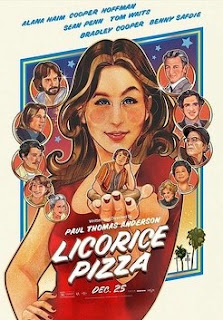
Currently, the Spectrum (an eight-screener on a main thoroughfare in the city) is showing several new releases that will contend for Oscars, including Licorice Pizza, Drive My Car, The Tragedy of Macbeth, and Nightmare Alley. I hope to see all of those before they leave the big screen, and will make an extra effort to do so. 

Going out to a movie still fills me with anticipation, freshens my step, and then fulfils that latent desire to be enveloped in the dark, alone or with friends, wrapped up in a story, with brilliant images, resonant sounds, and anonymous fellow theatergoers who sometimes have a word or two of comment during the credits.

I used to regularly run into friends at the Spectrum, and even made a new friend on occasion as we paused in the lobby to share our responses to a good film. Now, it's usually just the staff, who somehow still have jobs, but these days clearly seem to have not enough to do.

The Spectrum is part of a national chain (Landmark), which has theaters all over the United States, most of them in far larger markets than ours. I suppose those venues are making enough money to help keep this one open. But it's not something I would want to count on for long. 

So, please, if you value the presence of a great independent movie theater in your region, and wouldn't want to see it close, get up off the couch, grab a coat and the keys, and go support it. You'll be glad you did.

Note: I'm in Albany, so the Spectrum on Delaware Avenue is my go-to cinema - but there are several other small, independent movie theaters in the Capital Region that equally deserve your support, including the Criterion in Saratoga Springs and the Movieland 6 in Schenectady, both of which are owned by Bow Tie Cinemas, a national chain with 38 venues - coincidentally, the same number as Landmark.

Wednesday, January 12, 2022

Pieced Together at APL

Henry Klimowicz - Large Collections of Like a Lichen #2
cardboard and glue 2021
Perhaps one of the best-kept secrets on the local gallery scene is the Pine Hills Branch of the Albany Public Library, where expertly curated exhibitions of regional artists have been mounted about twice a year for quite some time.* And the current show, Pieced Together, is one of the best yet.

Organized by staff at Russell Sage College's Opalka Gallery, Pieced Together features 11 artists united by the theme of assemblage, an often overlooked art form that came into its own during the height of Modernism, in particular among Dadaists, often in the unassuming clothing of paper collage. Most of the work in this show follows fairly closely in that tradition, while some of it feels more connected to later periods of contemporary art that grew out of Modernism.

Altogether, this is a particularly lively collection of very accomplished work by well-established local favorites and a few relative newcomers, including one recent Sage graduate, Chloe Harrison, whose delicate matboard constructions show promise, while confirming her self-described fledgling status.
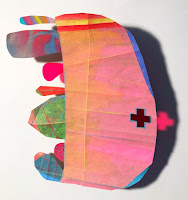
Beth Humphrey - Mutual Aid, 2020
spray paint, gouache, crayon, film on paper
Highlights from the show are many, even if one must perform something of a treasure hunt to find them all in the two-level space which, though not designed for art exhibitions, still serves well to showcase the work. Installations here always exploit the big central staircase, this time featuring two of my personal favorite artists of recent times: Beth Humphrey, who presents a constellation of small framed works on a mid-level wall that delight with their shapes, colors, and layerings; and Kenneth Ragsdale, who offers a suspended wire laden with playful, oversized folded-paper objects from his own quirky personal vocabulary of memories and imaginings.
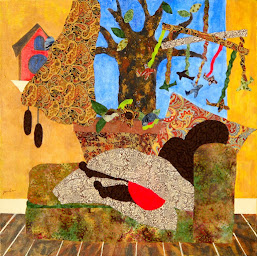
Paula Drysdale Frazell - Nap Time, 2015
acrylic paint and fabric on canvas
Another recent favorite artist, and one who I think deserves - and will get - more attention as time goes by, is Paula Drysdale Frazell. Her mixed-media works are less related to cut-paper collage than they are to painting and, in a sense, quilting, as they combine paint, fabric, and printed paper (such as maps) in colorful and playful compositions that draw from childhood memories and other family stories. Her works are both charming and thought provoking, making for a tricky balancing act that she handles comfortably.

Three of the artists in this show are strictly collagists of the cut-and-paste variety, forming a core for this selection, and being easily appreciated by any of us who have ever tried that medium (myself included); they are Niki Haynes, Juan Hinojosa, and Michael Oatman, all of whom have appeared in other local shows recently, and whose work remains fresh and fun.
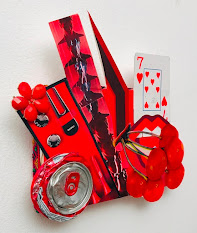
Juan Hinojosa - Lava, 2020
mixed media on panel with plastic,
soda can, wall paper, jewelry, ribbon
Hinojosa is easily the flashiest of this group, delving into consumer culture with abandon, embracing the brightest of colors and materials and, in the case of two works in this exhibition, utilizing metallic surfaces as a background. Eye-catching, to be sure, but for my taste a bit superficial.

Haynes, in contrast, hews to the mystical. Here, she presents a group of six small collages that coolly spook you with eyes that are watching from on high. Her technique is almost alarmingly simple, but it takes a lot of experience to get to simplicity and have it work so well, and Haynes has it.

Oatman throws us a curveball by installing a body of 26 comic-book collages he made in 1983, during the summer after his first year in college. I'd glimpsed these somewhere before, and was delighted to see them again, as they are witty, well crafted, and totally consistent with the work he is making today, nearly 40 years later. It takes courage to reveal early work, and in this instance I think it pays off.

The other artists in the show, which opened on Oct. 1 and will run through April 17, are Fern Apfel, Danny Goodwin, Henry Klimowicz, and Melinda McDaniel.

*Full disclosure: I recently joined the board of directors of the Friends and Foundation of the Albany Public Library, which has some input into programming at the branches, including arts programming.
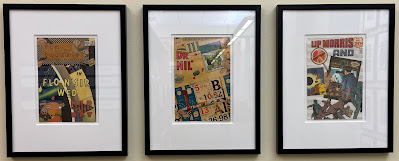
Michael Oatman - three examples from the collage series A Boy's History of the World in 26 Volumes (+1), 1983
photo by Michael Oatman


Sunday, January 2, 2022

Catch these while you can ...

What better way to start the new year than to catch up with an art show or two that you meant to see but got too busy to get to during the holidays.

There are a few good choices in the region that will end soon, including a great opportunity to take advantage of free admission at a world-renowned museum.

Return 2 Earth 2017, mixed media
by Alisa Sikellianos-Carter
First up, in order of ending date, would be the Annual Members Show at Saratoga Arts in Saratoga Springs, set to close on Jan. 8, closely followed by the annual Upstate Artists show at The Laffer Gallery in Schuylerville, which ends on Jan. 9. Both include a large cross-section of regional artists and are located not too far apart, providing a good opportunity to double up.

Two shows that will end on Jan. 14 also feature a great many regional artists: Gallery Mixtape, Vol. 1 at Collectiveffort in Troy, where a selection of BIPOC artists are showcased, and the Annual Members' Show at Albany Center Gallery. Well over 100 artists (myself among them) present one piece each at ACG, making for a super-eclectic viewing experience that is always popular with viewers.

An example of 20th-century Japanese
printmaking at The Clark
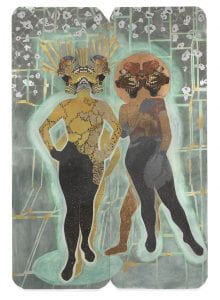
A solo show by one of the region's outstanding mid-career artists, Alisa Sikellianos-Carter, will re-open on Jan. 9 and run through Jan. 16 at Union College's Mandeville Gallery in Schenectady. Sikellianos-Carter, who was one of the three jurors of the 2021 Mohawk-Hudson Regional, works in large-scale mixed media with a healthy and entertaining nod toward Afrofuturism.

Perhaps most intriguing, an exhibition of 20th-century Japanese prints from the museum's collection will remain on view at The Clark Art Institute in Williamstown, Mass., through Jan. 30 - and admission to the museum will be free for the entire month. Competing Currents promises to be a highly pleasurable lesson on a unique corner of recent art history.

So, go forth and see some art! It will make a great beginning to your 2022.

Add note: This just in from the Albany Institute of History & Art - Fashionable Frocks of the 1920s, a fancy and fun romp among the clothing styles of the flapper era, has been extended through Jan. 9.

The Annual Members' Show at Albany Center Gallery is always a crowd-pleaser
photo by Daniel Joyce


Monday, December 6, 2021

Short Take: Fence Select 21 at ACCR

A New Blank Tablet: January 20, 2021 12:00 PM EST, oil on cradled hardwood by Susan Hoffer, is the juror's top choice in Fence Select 21
I’ve been remiss in taking so long to get to this year’s Fence Select show at the Arts Center of the Capital Region in Troy, because it always features a wide swath of the region’s best and upcoming artists, and it ends this Saturday. But, as I am often forced to say, better late than never.

This year’s edition of the show was juried by Dan Cameron, a noted critic whose local presence seems to be increasing lately, and the 51 artists included are overall quite worthy. I regularly refer to this annual exhibition as “the other Regional,” and this year’s edition pretty much lives up to the title; seven of the included artists were also in the 2021 Mohawk-Hudson Regional, and several others have been in previous editions of that show.

William Fillmore's Red Warning #2;
in the background is a painting
by D. Colin
photo provided
My biggest quibble with the current edition of Fence is that only a few of the selected artists have more than one work in it (specifically, six artists have two each) and those works aren’t presented together in any case. But the gallery looks good with the show as installed, and there are very few clunkers in it (I’ll leave it for you to decide which they are).

Among the outstanding pieces to my eye and mind were the following:

  • First-prize winner Susan Hoffer’s impressively self-actualizing studio view titled A New Blank Tablet: January 20, 2021 12:00 PM EST
  • ORT Project Rockwell-Nelson’s Anthropocene Epoch: Eat the Rich, a super-sharp photograph that features a live baboon in an oval-framed still life arrangement
  • Chris DeMarco’s lush, yet delicately colored photographs of a trailer park
  • Karen Gerstenberger’s two coastal monotypes
  • Jaime Courcelle’s oil on canvas It’s Not Goodbye
  • Take Out, a timely and wry nod to Edward Hopper by Marion Reynolds, and
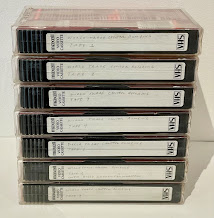
  • Michael Oatman’s elegiac stack of unwatched 9/11 videotapes (shown below)
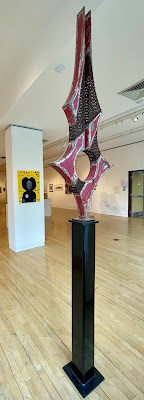
The exhibition’s other prize-winners are Royal Brown, for a futurist reinvention of found objects; Jeff Wigman, for a Bosch-like painting on wood panel, and William Fillmore, for a strikingly geometric steel sculpture.

The ACCR is open every day but Sunday; Fence Select 21 ends Saturday, Dec. 11.